Who Pays for School?
Students in the madrasas of Baghdad, Damascus and Cairo and the universities of Bologna, Paris and Oxford, about 1280
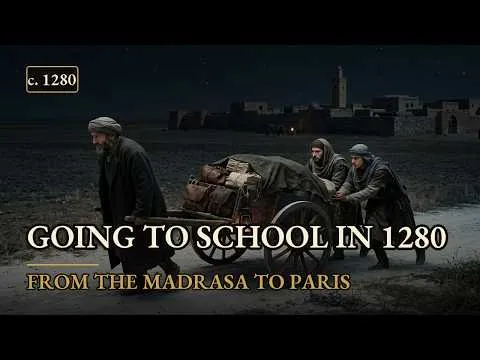 Watch the film
Sometime in 1268 or 1269 a family left the town of Harran by night, a father, four sons and a cart loaded with books. One of the sons, about six years old, would grow up to be the scholar Ibn Taymiyya. His story frames this week’s film, which asks a simple question about the year 1280: what was it like to be a student?
Two answers to one question
The film compares two worlds that rarely looked at each other: the madrasas of Baghdad, Damascus and Cairo, and the new universities of Bologna, Paris and Oxford. Both read Aristotle and both argued about him. The biggest difference was money. In a madrasa a student might be paid to study. In a European university he usually paid.
The cart story itself comes from an admiring biography written decades later: the family had no animals, the cart stuck, the enemy came close, they prayed and escaped. I treat it as a family memory, not a report. What we can say firmly is that they reached Damascus, a city whose rulers had been founding madrasas for generations, and that the father took over one of them, the Sukkariyya, where the boy studied.
Bread, a stipend and a license
A madrasa lived on a waqf, an endowment that could never be sold. Its income paid the teachers, fed the students and kept up the buildings, and the founder’s wishes set what was taught. The best-documented example is the Mustansiriyya in Baghdad, founded in 1233. A modern article, relying on later chroniclers, says each of its four schools of law opened with sixty-two students, and that a student received a dinar (probably monthly) plus bread, cooked food and bedding, while a teacher got twelve dinars and a mule. Those are the founder’s terms, not proof of daily life, and the article’s notes are not always consistent. The library figure of eighty thousand volumes comes from a single later chronicler and may be inflated. The madrasa itself came through the Mongol sack of 1258.
Teaching was personal. Students sat in a circle around a teacher and practiced disputation, defending an opinion against every objection. When the teacher was satisfied he granted an ijaza, a license in his own name. Women earned and gave them too: four of the more than two hundred teachers listed for Ibn Taymiyya were women, and Zaynab bint al-Kamal, born in 1248, taught hadith in Damascus into her nineties. In the same city al-Nawawi, said by his biographers to study for twelve hours at a stretch, ran a hadith school from 1267 until his death in 1277.
Guilds, books and banned ideas
Bologna turned the madrasa’s arrangement upside down. Foreign students banded together into guilds grouped by homeland, hired the professors, fined them for missed lectures and could go on strike. Paris was a guild of masters under church supervision. Its statutes of 1215 required a lecturer in arts to be twenty and to have studied six years (some modern books say twenty-one). At Oxford, students rented houses and halls. Colleges began as charity: Robert de Sorbon founded his house in Paris, about 1257, for poor students of theology.
Books were copied by hand, and stationers rented them out in sections called peciae so many students could copy at once. Many of the texts had come from Arabic through translators at Toledo. That brought trouble: Aristotle’s natural philosophy was banned at Paris in 1210, yet by 1255 nearly all his known works were set texts. In March 1277 the bishop of Paris condemned 219 propositions, some touching the ideas of Aquinas, who had died three years earlier. A later story says Roger Bacon was jailed afterward, but it first appears long after his death and modern scholars doubt it.
What came next
A madrasa graduate could become a teacher, a mufti or a judge, like Ibn Khallikan, chief judge of Damascus in the 1260s. A university man might serve a king or a bishop; Robert Kilwardby became Archbishop of Canterbury and banned thirty theses at Oxford eleven days after the Paris condemnation. Women are almost absent from the university record. Bologna remembers a Bettisia Gozzadini, said to have taken a law degree in 1237, but parts of her story rest on much later writers.
In 1284 Ibn Taymiyya’s father died, and the boy from the cart, now twenty-one, took his chair at the Sukkariyya. Fifteen years after the night road, he was the one doing the teaching.
Watch the film for the full tour, then follow any of these claims back through the sources below.
Sources
- Wikipedia, “Ibn Taymiyya” (the flight from Harran in 1268 or 1269; the Sukkariyya; his teachers; the chair in 1284)
- Ibn Abd al-Hadi, al-ʿUqud al-durriyya, Arabic biography of Ibn Taymiyya (the cart of books)
- Wikipedia, “Harran” (under Mongol rule from 1260, abandoned in 1271)
- Wikipedia, “Madrasa” (endowments, the circle, disputation, the madrasas of Damascus)
- Wikipedia, “Waqf” (how an endowment worked)
- Nabila A. Dawood, “Scholarly Traditions of the Schools in Baghdad: The Mustansiria as a Model,” Muslim Heritage (students, stipends and rations, as later chroniclers report them)
- Wikipedia, “Mustansiriyya Madrasa” (founded 1233; survived 1258; the library)
- Wikipedia, “Al-Nawawi” (born 1233; the Ashrafiyya from 1267; died 1277)
- Wikipedia, “Salihiyya Madrasa” (Cairo, 1242, all four schools of law)
- Wikipedia, “Ijazah” (the license, and the Makdisi debate)
- Wikipedia, “Zaynab bint al-Kamal” (born 1248, hadith teacher in Damascus)
- Wikipedia, “University of Bologna” (student guilds, hiring and fining professors)
- Wikipedia, “Nation (university)” (the nations of Bologna and Paris)
- Robert S. Rait, Life in the Medieval University (1912), Project Gutenberg (Bologna degrees, halls and colleges, later rules)
- Fordham Medieval Sourcebook, Robert de Courçon, Statutes for the University of Paris, 1215 (ages and years of study)
- Wikipedia, “University of Oxford” (growth after 1167)
- Wikipedia, “Robert de Sorbon” (the Sorbonne, about 1257)
- Wikipedia, “Pecia” (renting books by sections)
- Wikipedia, “Toledo School of Translators” (Arabic science into Latin)
- Wikipedia, “Condemnations of 1210 to 1277” (Sens, 1215 and the 219 propositions of 1277)
- Wikipedia, “Thomas Aquinas” (Paris, 1245 to 1272; died 1274)
- Wikipedia, “Roger Bacon” (the Opus Majus of 1267; the doubted prison story)
- Wikipedia, “Ibn Khallikan” (chief judge of Damascus; the dictionary of 1274)
- Stanford Encyclopedia of Philosophy, “Robert Kilwardby” (the Oxford ban of 18 March 1277)
- Wikipedia, “Bettisia Gozzadini” (the Bologna tradition, 1237)
This letter was drafted with AI assistance from the film’s researched script and its source notes. The sources are listed above; corrections are welcome and noted on the page. Send a correction