What the Physician Carried
Healers, drugs and medical books between China, Persia and Cairo, 1222 to 1377
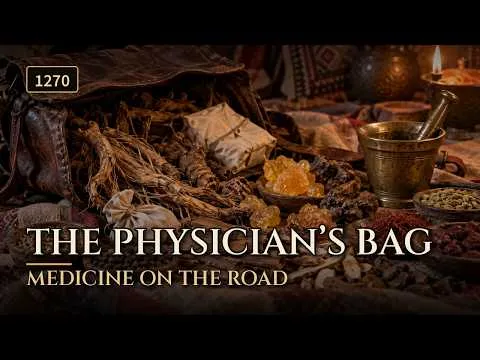 Watch the film
A physician lays three fingers on a patient’s wrist and presses, lightly at first, then deeper, then deeper again. The technique is Chinese. This week’s film imagines it being studied in Tabriz, in Persia, around 1313, and asks how it traveled that far. It is a history of carrying, not of curing: nothing in it claims that any old remedy worked.
Many medicines, one road
No single medicine ruled the thirteenth-century world. Physicians in Cairo and Persia followed Galen and Avicenna and their four humors. Chinese doctors thought in channels and in the balance of yin and yang. Indian healers spoke of three doshas. The theories had little in common, but most healers leaned on herbs, diet and the pulse, and that shared practice gave them something to exchange.
The Mongols made the exchange possible, partly by force. The historian Thomas Allsen points out that they collected physicians much as they collected soldiers and craftsmen. Khubilai Khan, who had gout, kept a crowd of healers in his traveling camp, and a Mongol ruler could draw on Muslim, Chinese, Tibetan, Korean, Uighur and Indian healers, and on Nestorian Christians too. In 1263 Khubilai set up an Office of Western Medicine under Aixue, a Nestorian whose service to the Mongols went back to Güyük Khan’s reign. His church had a long medical memory: Hunayn ibn Ishaq, a ninth-century Nestorian of Baghdad, had translated Galen into Syriac and Arabic. In 1292 the court founded a pair of Muslim drug bureaus, one in Dadu and one in Shangdu.
The empire’s founder wanted more than medicine. Camped near the Hindu Kush in 1222, Chinggis Khan is said to have asked the Daoist master Qiu Chuji whether there was a way to escape death. As Qiu’s disciple tells it, the reply was that life can be nourished, but no elixir makes a man immortal.
What was in the bag
Drugs moved in both directions. Marco Polo describes rhubarb growing thickly in the mountains of western China, bought up by merchants and shipped far and wide. The Yuan history, as the scholar Angela Schottenhammer reads it, records Khubilai sending a hundred thousand taels of gold to his kinsman Abaqa, the Ilkhan of Persia, to buy medicinal drugs from Ceylon. Her list of the “Huihui” (Muslim) drugs used in Yuan China includes myrrh, frankincense, mastic, saffron, camphor, asafoetida, opium and theriac, and an early Ming formulary still keeps prescriptions of Persian origin, annotated in Arabic script.
In the west, Ibn al-Baytar of Málaga, who died in Damascus in 1248, finished a compendium of roughly fourteen hundred plants, foods and drugs, gathered from about a hundred and fifty Arabic and twenty Greek writers. China had its own state drug trade. The Song set up a public pharmacy in 1076, selling medicines already made up and keeping speculators in check, and within a century there were dozens of branches.
Hospitals and a book
In Cairo, Sultan Qalawun began a hospital in 1284 that was taking patients by early 1285. The deed that endowed it promised to keep patients, men and women, rich or poor, local or foreign, until they were well, at the hospital’s expense. Accounts mention wards split by sex and illness, running water and fountains, and, some say, a ward for mental illness. Ibn al-Nafis, a Cairo physician who died in 1288, had argued in a commentary of around 1242 that blood crosses from one side of the heart to the other by way of the lungs rather than through Galen’s invisible pores.
In China, Khubilai’s Imperial Academy of Medicine was split into thirteen specialties, acupuncture, eye disease, bones and the illnesses of children among them, and physician families were registered as hereditary households, spared most levies.
The book at the center of the film came from Tabriz. Rashid al-Din, born to a Jewish family in Hamadan, became a Muslim, served Abaqa as a physician and rose to vizier in 1298. Chinese physicians were sent to Iran, their texts were put into Persian, and the result, completed in 1313, was the Treasure Book of the Ilkhan on the Sciences of Cathay. It drew on Chinese writing about the pulse, acupuncture and drugs. Skills, historians stress, usually moved in people, not in written plans. Rashid al-Din himself was put to death in 1318, aged seventy, when rivals charged him with poisoning Öljeitü, the Ilkhan he had served.
Paper, powder and plague
The roads carried other things too. Paper, a Chinese invention, was being made in Spain by about 1050 and in Genoa by 1235, and by the 1280s the mills of Fabriano were watermarking their sheets. A Persian story collection of about 1232 describes an iron fish, rubbed with a lodestone, floating in a bowl and swinging round to point south. Saltpeter first turns up in Arabic in Ibn al-Baytar’s drug book, under a name that means Chinese snow.
And the roads carried disease. Gravestones near Lake Issyk-Kul, dated 1338 and 1339, blame pestilence for the deaths, and scientists have recovered plague DNA from those graves. By 1346 the Black Death had reached the Black Sea, and trade may have brought it there. In 1377 Ragusa made new arrivals wait thirty days before entering, a rule often called the first quarantine. No remedy in any healer’s kit could have stopped it.
The film is the quickest way into this story, and the sources below are the way to test it.
Sources
- Thomas Allsen, Culture and Conquest in Mongol Eurasia (2001), ch. 16 “Medicine” (physicians conscripted; Khubilai’s gout; the traditions open to a Mongol ruler)
- Angela Schottenhammer, “Huihui Medicine and Medicinal Drugs in Yuan China” (2013) (the Office of Western Medicine, 1263; the Muslim bureaus, 1292; the drug list; the gold sent to Abaqa; the Huihui yaofang)
- Wikipedia, “Isa Kelemechi” (Aixue, a Nestorian Christian in Mongol service)
- Britannica, “Hunayn ibn Ishaq” (Galen in Syriac and Arabic)
- Wikipedia, “Qiu Chuji” (the conversation with Chinggis Khan in 1222, as told by Qiu’s disciple)
- Marco Polo, The Book of Ser Marco Polo, Yule translation (1903), the chapter on Sukchur (rhubarb)
- Wikipedia, “Ibn al-Baytar” (his compendium; died in Damascus, 1248)
- Science in Context, “Commercializing Medicine or Benefiting the People: The First Public Pharmacy in China” (the Song pharmacy of 1076)
- Wikipedia, “Qalawun complex” (the Cairo hospital, 1284 to 1285)
- Aramco World, “The Islamic Roots of the Modern Hospital” (the founding deed)
- Wikipedia, “Bimaristan” (wards by sex and illness; water in the buildings)
- Wikipedia, “Ibn al-Nafis” (the commentary of about 1242 and the lungs)
- “Selection and Management of Medical Officials during the Yuan Dynasty” (PMC 10565024) (the Imperial Academy’s thirteen branches; hereditary physician households)
- Britannica, “Rashid al-Din” (his family, conversion, service as physician and rise to vizier)
- Wikipedia, “Rashid al-Din Hamadani” (his foundation in Tabriz; his death in 1318)
- Vivienne Lo and Michael Stanley-Baker (eds.), Routledge Handbook of Chinese Medicine, introduction (the Treasure Book of the Ilkhan, 1313)
- Journal of the History of Biology (2025), on the Chinese sources of a fourteenth-century Persian medical book (physicians sent to Iran; the pulse poem and acupuncture classic)
- Wikipedia, “Fabriano” (papermaking and watermarks)
- Hand Papermaking, “Italy, the Birthplace of Western Paper” (Spain by about 1050; Genoa by 1235)
- Petra Schmidl, “Two Early Arabic Sources on the Magnetic Compass” (al-Awfi’s iron fish, c. 1232)
- Joseph Needham, “The guns of Kaifeng-fu” (saltpeter as “Chinese snow” in Ibn al-Baytar)
- Spyrou et al., “The source of the Black Death in fourteenth-century central Eurasia,” Nature (2022) (the Issyk-Kul graves, 1338 and 1339)
- Britannica, “Today in History, July 27” (Ragusa’s thirty-day wait, 1377)
This letter was drafted with AI assistance from the film’s researched script and its source notes. The sources are listed above; corrections are welcome and noted on the page. Send a correction