One Edge of the World
Acre, the friars, the Black Sea ports and the Vivaldi galleys: Latin Europe in the Mongol age, 1241 to 1309
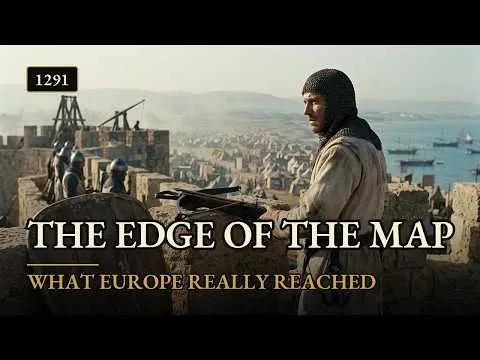 Watch the film
In May 1291 the Mamluk army of Egypt broke into Acre, the last great city Latin Christians held on the coast of the eastern Mediterranean. The Templars’ harbor fortress lasted ten more days and fell on the twenty-eighth. In that same year Arghun, the Ilkhan who ruled Persia, died; a pair of Genoese galleys headed out into the Atlantic; and the Polos were getting ready to leave China. This week’s film asks why Europe was looking outward in the 1290s, and what it actually reached. The honest answer is smaller than the legend.
Letters and friars
Europe met the Mongols first as a threat. Their armies struck Poland and Hungary in 1241, and Rome and the courts of Europe wanted to find out who these riders were. The pope’s first envoy, sent in 1245, was John of Plano Carpini, an aging Franciscan, and in August 1246 he saw Güyük raised to Great Khan. The khan’s reply, which Carpini brought back, ordered the pope and Europe’s rulers to come in person and swear loyalty. In 1253 William of Rubruck set out with King Louis IX’s backing, though not as an envoy, and at Karakorum he met a metalworker from Paris and a woman from Lorraine.
The Ilkhans, the Mongol rulers of Persia, had their own reasons to seek friends in the West, since they too were fighting the Mamluks. Ilkhanid envoys attended the Council of Lyon in 1274, and a crusade was planned for 1278, but the plan lost momentum after the pope’s death in 1276. In 1287 Arghun sent Rabban Sauma, a Church of the East monk born near present-day Beijing. He saw cardinals in Rome, spent about a month at the French court and met Edward of England in Gascony, who was friendly but would not commit. Arghun then proposed a joint campaign against Egypt, to be launched over the winter of 1290 and into spring 1291. He was dead by March 1291, Acre fell in May, and historians still argue about how close an alliance ever came.
The merchants’ sea
Trade, meanwhile, had not waited for diplomacy. The Golden Horde ruled the steppe coast north of the Black Sea, and Italians did business there under its authority. In 1261, a few months before the Byzantines retook Constantinople, Emperor Michael Palaiologos gave Genoa trade privileges, possibly including access to the Black Sea. Caffa, in the Crimea, was in Genoese hands from the 1260s or 1270s (1266 is the traditional date), and a notary’s register kept there in 1289 and 1290 survives. Port records from Genoa and Venice show that some of what was bought and sold was people: slaves from the steppe and the lands around the Black Sea, carried to Egypt and Italy. The film says so plainly, and so should we.
The Italian republics fought one another as fiercely as any foreign enemy. Genoa crushed Pisa at Meloria in 1284 and beat Venice at Curzola in 1298. A later tradition puts Marco Polo among the Venetian prisoners at Curzola, though other evidence points to a smaller clash, probably in 1296. Either way, his book says he dictated it in a Genoese prison in 1298, to a writer of romances named Rustichello of Pisa.
Two who went, and the other edges
The Polo brothers had reached Kublai Khan once already and returned in 1269. They went back east in 1271, this time with Niccolò’s son Marco, and around 1291 or 1292 they sailed home from China as escorts to the princess Kököchin, bound for Persia. The book says only eighteen of some six hundred passengers survived. Did Marco really go? In 1995 the historian Frances Wood suggested he might never have traveled beyond Persia. Most specialists today reject that, citing how accurately he describes paper money and the salt revenues. About a hundred and fifty manuscripts survive, and they differ. In 1294 the Franciscan John of Montecorvino reached Khanbaliq, built a church there in 1299 and was named archbishop in 1307. Countless others made the trip, traders, translators and captives, without leaving a name.
Closer to home, Europe was pushing out on other fronts. Castile took Seville in 1248, Aragon took Sicily after the Sicilian Vespers of 1282 and Minorca in 1287, and the Teutonic Order had largely conquered Prussia by 1283. Far to the northwest, Greenland’s Norse settlers submitted to the king of Norway in 1261. New tools helped: the magnetic compass, known in China by 1088 and first recorded in western Europe around 1190, and, probably late in the 1200s, the Carta Pisana, usually described as the oldest sea chart to survive.
What Europe reached
In May 1291 Ugolino and Vandino Vivaldi left Genoa in two galleys, aiming for India across the Atlantic. The final word of them puts them at a place called Gozora, usually identified with Cape Nun in Morocco. Nobody heard from them again.
A world map made at Hereford around 1300 puts Jerusalem at the center and monsters at the edges, while a sailor’s chart shows only coasts and ports. And the East, as far as surviving records show, barely looked back: Chinese and Mongol writings about the Franks are few. What Europe reached was a handful of Black Sea ports, merchants in Tabriz, one church in Khanbaliq, and perhaps a Moroccan cape. It stood at one edge of the Mongol world, not at its center.
Start with the film, then follow whichever thread pulls at you through the sources below.
Sources
- Wikipedia, “Siege of Acre (1291)” (the dates of the siege; the Templar fortress)
- Wikipedia, “Giovanni da Pian del Carpine” (the mission of 1245 to 1247; Güyük’s enthronement)
- Wikipedia, “William of Rubruck” (Karakorum, the debate of 1254)
- Wikipedia, “Guillaume Boucher” (the Parisian metalworker at Karakorum)
- Wikipedia, “Second Council of Lyon” (the Ilkhan’s envoys, 1274)
- Wikipedia, “Rabban Bar Sauma” (his embassy of 1287 to 1288)
- Wikipedia, “Arghun” (his letters and death in 1291)
- Wikipedia, “Franco-Mongol alliance” (how close an alliance came)
- Wikipedia, “Treaty of Nymphaeum (1261)” (Genoa’s privileges)
- Wikipedia, “Genoese Gazaria” (Caffa and the Crimean ports)
- Michel Balard, Les actes de Caffa du notaire Lamberto di Sambuceto, 1289 to 1290 (catalog record)
- Wikipedia, “Genoese slave trade” (people sold through the Black Sea ports)
- Wikipedia, “Battle of Meloria (1284)”
- Wikipedia, “Battle of Curzola” (1298)
- Wikipedia, “Marco Polo” (the prison in Genoa, Rustichello, the manuscripts and the debate over his journey)
- Wikipedia, “Kököchin” (the voyage to Persia)
- Wikipedia, “John of Montecorvino” (Khanbaliq, 1294 to 1307)
- Wikipedia, “Prussian Crusade” (the conquest of Prussia by 1283)
- Wikipedia, “Norse settlements in Greenland” (1261 and after)
- Wikipedia, “Carta Pisana” (the oldest surviving sea chart, as often described)
- Wikipedia, “Vivaldi brothers” (the voyage of 1291 and Gozora)
- Wikipedia, “Hereford Mappa Mundi” (the world map of about 1300)
- Na Chang, thesis abstract on Chinese and Mongol knowledge of Europe (Cambridge repository)
This letter was drafted with AI assistance from the film’s researched script and its source notes. The sources are listed above; corrections are welcome and noted on the page. Send a correction