Four Desks in 1270
Brush, reed, quill, bark and palm leaf along the Silk Road, and Kublai’s new script of 1269
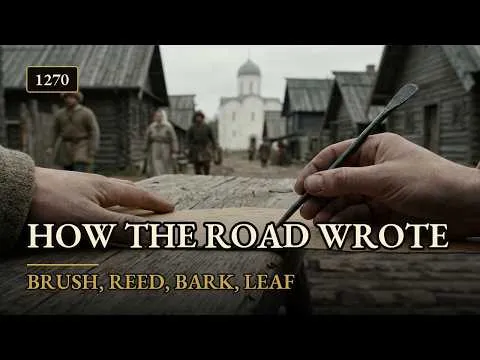 Watch the film
Most of my Silk Road films follow goods: silk, pepper, horses, silver. This one follows something smaller, the thing in a writer’s hand. Around 1270, a clerk in China, a calligrapher in Baghdad, a townsman in Novgorod and a scribe in south India were all writing at once, and hardly any two of them used the same tools.
Brush and stone
In China the desk was built around a set so standard it had a name, the Four Treasures of the Study: brush, ink stick, paper and inkstone. The ink came as a hard stick of pine soot bound with animal glue, ground on a wet stone until it was as dark as the writer wanted. Brushes were hair from goats, rabbits or weasels, set in bamboo. When William of Rubruck heard about the people of Cathay in 1254, what struck him was that they wrote with something like a painter’s brush.
Paper had long since replaced the bamboo strips of earlier centuries; tradition gives a court official, Cai Lun, credit for improving it in the year 105. And in Kublai’s China one more tool mattered: the seal. Marco Polo says the khan’s paper money passed through many officials’ stamps before the last, red seal of the ruler made it valid.
Reed and paper
Further west, the pen was a reed, the qalam, trimmed with a small knife so that the angle of the cut shaped every letter. The Baghdad calligrapher Yaqut al-Musta’simi is credited with refining that slanted cut. He lived through the Mongol sack of the city in 1258 and died in 1298. A scribe’s pens and knife rode in a long case, and one made in western Iran around 1281, now in the British Museum, is brass inlaid with silver and gold and covered with zodiac signs. A working tool could also be a jewel.
What Yaqut wrote on was paper, made in Samarkand by the 700s and, according to the records, in a Baghdad mill by 794 or 795. You may have heard that Chinese prisoners taken at the Battle of Talas in 751 brought the secret west. That tale first appears centuries later, and the historian Jonathan Bloom treats it as just a story, since Samarkand seems to have had paper before the battle. By about 1000, rag paper had largely pushed aside papyrus and parchment in Muslim lands.
Skin, wax, bark and leaf
Latin Europe was slower. Its books were still parchment, skins soaked, limed, stretched and scraped thin, written with goose quills in iron gall ink that darkens as it dries. Notes went on wax tablets that could be smoothed and reused. Paper was viewed with suspicion: in 1231 Frederick II barred it from notarial records in his Sicilian kingdom, and Italy’s mills at Fabriano are first mentioned only in 1276.
My favorite part of the film is in the north. Since 1951, archaeologists in Novgorod have dug up more than a thousand letters scratched on birch bark with iron points, dating from the 1000s to the 1400s. They are wonderfully ordinary: debts, shopping lists, a request for a shirt. Among them are seventeen pieces of a child’s practice letters and doodles, dated by one reckoning to about the middle of the thirteenth century. In Kashmir, scribes also used birch bark, while in south India they cut letters into palm leaves, rubbed pigment into the cuts and strung the leaves together.
The khan’s alphabet
The Mongols had borrowed the Uyghur script early in Genghis Khan’s rise. Kublai wanted more. In 1260 he made the Tibetan monk Phags-pa his State Preceptor and asked him for a new script, built from Tibetan letters and written in columns like Chinese. An edict of 1269 made it the script for official documents, and teachers were assigned the next year. It never caught on: officials were slow to learn it, and after the dynasty fell in 1368 it was dropped. It survives mostly where an empire stamps its name, on seals, stone edicts, pass tablets and banknotes.
What I take from all this is how uneven the picture was. Paper had crossed Asia, but Europe was still scraping skins, and a letter in one script often needed a translator before it could travel on, as Rubruck found at a Mongol camp a few days short of the Volga in 1253.
The film shows each of these hands at work; the sources I relied on are listed below if you want to follow any of them further.
Sources
- Wikipedia, “Four Treasures of the Study” (brush, ink stick, paper, inkstone)
- Wikipedia, “Inkstick” (pine soot and animal glue)
- Wikipedia, “Bamboo and wooden slips” (writing before paper)
- Wikipedia, “Papermaking” and “History of paper” (Cai Lun, Samarkand, the Baghdad mill)
- Encyclopaedia Iranica, “Paper and papermaking” (Jonathan Bloom on Samarkand, Talas and rag paper)
- historyofinformation.com, on the Talas story, Frederick II’s ban and the Fabriano mills
- Wikipedia, “Qalam” (the cut reed pen)
- British Museum, collection record W_1891-0623-5 (the inlaid brass pen box, c. 1281)
- Wikipedia, “Yaqut al-Musta’simi” (the oblique cut; survived 1258, died 1298)
- Wikipedia, “Ibn al-Nadim” (the Fihrist of 987)
- Wikipedia, “Papyrus” (the papal decree of 1057)
- Wikipedia, “Parchment” (how skins were prepared)
- Wikipedia, “Quill” and “Iron gall ink” (Isidore of Seville; ink that darkens)
- Wikipedia, “Wax tablet” (notes and accounts in Europe)
- Wikipedia, “Fabriano” (paper mills first mentioned in 1276)
- Wikipedia, “Birch bark manuscript” (Novgorod finds since 1951; Kashmir)
- Wikipedia, “Onfim” (the boy’s practice letters, by one dating about 1260)
- Gulf News, “In Novgorod, history grows on trees” (the birch bark letters)
- Wikipedia, “Palm-leaf manuscript” (stylus, pigment and string)
- Wikipedia, “ʼPhags-pa script” (the edict of 1269, its limited use, its survivals)
- BabelStone, Phags-pa overview (State Preceptor in 1260; the schools of 1270)
- William of Rubruck, Journey, trans. W. W. Rockhill (the Cathay brush; the scribes at Sartach’s camp)
- Marco Polo, Travels, Book 2, ch. 24, trans. Henry Yule (seals on the khan’s paper money)
This letter was drafted with AI assistance from the film’s researched script and its source notes. The sources are listed above; corrections are welcome and noted on the page. Send a correction