Bells, Calls and Chants
How people prayed across the Mongol world, from Goryeo to Cairo, around 1280
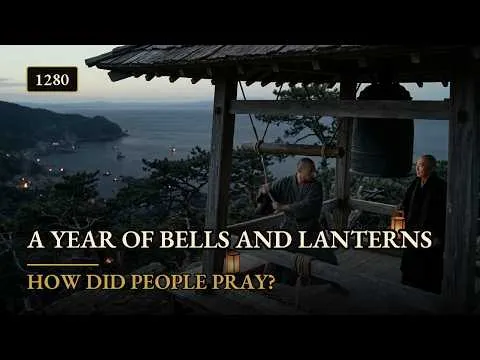 Watch the film
Around 1280, on a single morning, you might have heard a temple bell above a harbor in western Japan and, far to the west, a call to prayer from a Cairo minaret. This week’s film walks the ground between them from east to west and asks one question at every stop: how did ordinary people pray?
The khans’ bargain
The Mongols ruled or reached much of that ground, and they did not impose a faith. Their edicts freed clergy of many religions from taxes and forced labor, in return for prayers for the khan’s long life. The favor had conditions. From 1264 Kublai taxed monks who traded or farmed, and anyone who defied the khan, as Alamut and Baghdad learned, could still be destroyed. For a traveler, a Sufi lodge or a monastery guest room was often the likeliest place to find a meal and a bed.
Lanterns, mountains and new teachers
Goryeo was Buddhist by law, and its court backed temples and great ceremonies. One lantern festival honored the Buddha; its sister, the Palgwanhoe, honored heaven, the sacred mountains, the rivers and the dragon god, and the dynasty’s founder had told his heirs never to change either. In the villages, shamans called mudang spoke for the spirits. After the Mongols burned Goryeo’s first carved Buddhist canon in 1232, the court on Ganghwa Island ordered a new one, cut from 1237 over about twelve years into more than eighty thousand wooden blocks that still survive. After the peace of 1259, King Chungnyeol married a daughter of Kublai, and the court stayed Buddhist. But the scholar An Hyang brought Zhu Xi’s writings home from China and hoped Confucianism would replace Buddhism, an argument that outlived the kingdom.
Japan was changing too. Hōnen taught that anyone could reach Amida’s Pure Land by calling on his name, and Ippen walked the roads handing out slips marked with it while his followers danced as they chanted. Nichiren had warned the Kamakura rulers in 1260 that foreign armies would come, and when the Mongols landed in 1274, his followers saw the warning fulfilled. Zen arrived by ship with Chinese masters, and in 1282 the regent Hōjō Tokimune built Engaku-ji, by one account to honor the dead on both sides. The kami stayed: Hachiman, a protector of warriors, was honored at Hakozaki Shrine, which burned in 1274 and was rebuilt. The monk Ninshō is said to have run a hospital near Gokuraku-ji in the 1280s, but the later counts of his patients vary so widely that none can be trusted.
From Dadu to the Nile
Kublai tolerated many faiths but favored Tibetan Buddhism, and the monk Phagspa became his teacher in 1258. The Daoists lost a great court debate that year, and their privileges with it. The port of Quanzhou had a mosque dating from 1009 or 1010, Buddhist temples, Christians under the Yuan, and a Shiva temple raised by Tamil merchants whose carved stones now rest in a Buddhist temple. There was friction too. In 1279 or 1280 Kublai banned the Muslim way of slaughtering animals. Rashid al-Din later claimed most Muslims left China, which is probably an exaggeration, and the ban was lifted some years on. In 1294 a Franciscan, John of Montecorvino, reached the capital, where Christians of the Church of the East already lived.
Farther west, Hulagu ended the Abbasid caliphate at Baghdad in 1258, yet the scholar Nasir al-Din Tusi served him and began an observatory at Maragha. Persia’s Mongol rulers changed faiths over time, and in 1295 Ghazan made Islam the state religion. In Konya, Christians and Jews walked in the crowd behind the poet Rumi’s body in December 1273. In Cairo, Sultan Qalawun built a hospital, a school and a tomb side by side in 1284 and 1285. Egypt’s Copts kept their long fasts, and each year pilgrims joined the escorted caravan to Mecca.
One spring, three faiths
At the western edge, the Byzantine emperor Michael VIII, fearing an attack from Charles of Anjou, accepted union with the Roman church at Lyon in 1274. His own people rejected it, and his son undid it. In 1291 the Mamluks took Acre, the last major Crusader stronghold.
My favorite moment comes near the end. Work out the calendars for spring 1274, using tabular reckoning and Julian dates, and Ramadan begins around March 11, Passover falls on March 24 and Easter on April 1. For a few weeks, Muslims, Jews and Christians were keeping their holy seasons at once. The pilgrim, priest and householder the film shows at the very end are imagined, since no record names such people, but their prayers were probably not so different.
Watch the film for the whole map, and use the list below to follow any thread further.
Sources
- Wikipedia, “Religion in the Mongol Empire” (clergy spared taxes and labor; the 1264 tax on trading monks; the 1258 debate)
- Columbia, Asia for Educators, “The Ten Injunctions of Wang Kon” (the lantern festival and the Palgwanhoe)
- UNESCO, nomination file for Yeondeunghoe, the lantern lighting festival
- Wikipedia, “Korean shamanism” (the mudang)
- Wikipedia, “Tripitaka Koreana” (burned in 1232; recarved from 1237 on more than 80,000 blocks)
- Wikipedia, “Chungnyeol of Goryeo” (marriage to Kublai’s daughter; royal names)
- Wikipedia, “An Hyang” (born 1243; Zhu Xi’s writings)
- Wikipedia, “Kamakura Buddhism” (the new schools; Ninshō’s hospital and its uncertain numbers)
- Wikipedia, “Ippen” (the slips and the dancing chant, about 1279)
- Wikipedia, “Nichiren” (the warning of 1260)
- Wikipedia, “Mugaku Sogen” (Wuxue Zuyuan; Engaku-ji, 1282)
- Wikipedia, “Hakozaki Shrine” (Hachiman; burned in 1274)
- Wikipedia, “Drogön Chögyal Phagpa” (Kublai’s teacher from 1258)
- Wikipedia, “Quanzhou” and “Kaiyuan Temple (Quanzhou)” (the mosque, the Shiva temple stones)
- Wikipedia, “Islam during the Yuan dynasty” (the slaughter ban of 1279 or 1280)
- Wikipedia, “John of Montecorvino” (arrival 1294; churches of 1299 and 1305)
- Wikipedia, “Nasir al-Din al-Tusi” (the Maragha observatory)
- Wikipedia, “Ilkhanate” and “Ghazan” (Tegüder; Islam as state religion, 1295)
- Wikipedia, “Rumi” (his funeral at Konya, 1273)
- Wikipedia, “Qalawun complex” (hospital, school and tomb, 1284 to 1285)
- Wikipedia, “Hajj” (Mamluk caravans with escorts and physicians)
- Wikipedia, “Michael VIII Palaiologos” and “Second Council of Lyon” (the union of 1274 and its failure)
- Wikipedia, “Siege of Acre (1291)”
- Our own calendar calculation for spring 1274 (tabular Islamic and Julian dates for Ramadan, Passover and Easter)
This letter was drafted with AI assistance from the film’s researched script and its source notes. The sources are listed above; corrections are welcome and noted on the page. Send a correction