A Kingdom Kept
Goryeo, the Choe generals and the Mongol khans, from the coup of 1170 to the woodblocks at Haeinsa
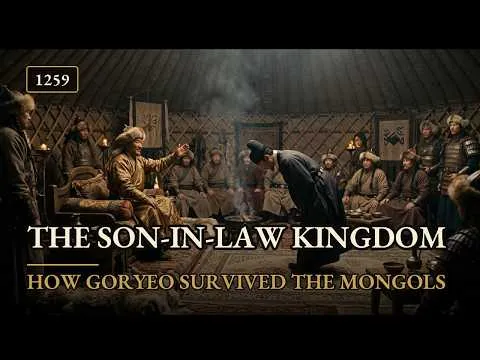 Watch the film
On a mountain in southern Korea, in long wooden halls built to let the air move through, stand about eighty thousand carved printing blocks for the Buddhist scriptures. They were cut in the middle of a war, as a prayer that the Mongol armies would turn back. This week’s film uses them as a frame for a harder story: how the kingdom of Goryeo came through a century of generals and khans with its dynasty still standing.
Kings without power
The trouble began well before the Mongols. In 1170 army officers, long treated as inferior to civil officials, turned on them during a royal outing, killed many (more than fifty, by the court history’s count) and sent the king into exile. A string of strongmen followed until 1196, when Choe Chung-heon took power. His family ruled for sixty-two years through four generations.
The Choes never wore the crown. They set kings up and removed them, kept a private guard, and ran the state from offices in their own houses, where appointment lists were drawn up for the king to approve. When Mongol demands grew in 1232, Choe U moved the court to Ganghwa Island, just off the coast. The Mongols were horsemen with little experience at sea, and the court stayed there for thirty-eight years while the mainland was told to take shelter in mountain forts and islands.
A war on the mainland
From 1231 to 1259 the Mongols came back again and again; historians count the campaigns differently. They never took the island, but they ravaged the country around it. In 1232, at a small earthen fort called Cheoin, a Mongol commander was killed by an arrow; the court history credits a monk named Kim Yun-hu, defending the place with other monks and local villagers of low status. In 1238 the great wooden pagoda of Hwangnyongsa burned. For the campaign of 1254 and 1255 the court history counts more than two hundred thousand people carried off, and famine followed.
It was in these years that the court on Ganghwa began carving the scriptures again, replacing a first set lost to fire. The Choes helped pay. In 1237 the poet and official Yi Gyu-bo wrote the prayer for the work, recalling that an earlier carving had been vowed against the Khitan, and the Khitan had gone home.
By 1258 the Choes had lost their own men. A former retainer, Kim Jun, joined with scholar-officials and killed the last of them. The next year Goryeo made peace.
The khan’s son-in-law
What came next was shaped by a lucky choice. The heir, Wang Jeon, was on his way to the Mongol court in 1259 when he learned the Great Khan Möngke had died. He went instead to Möngke’s brother Kublai and backed his claim. Kublai is said to have been delighted, and promised Goryeo it could keep its own customs. Wang Jeon came home to reign as King Wonjong.
Peace still had a price: hostages, soldiers, grain and a resident Mongol overseer among the duties scholars describe. Some generals resisted. Wonjong was deposed in 1269 and restored under Mongol pressure. When the court finally left the island in 1270, the elite Sambyeolcho refused to disband and held out on Jindo and then Jeju until April 1273, fought by Goryeo men as well as Mongols.
In 1274 the crown prince married Kublai’s youngest daughter and came home that year as King Chungnyeol. He had already appeared once in Mongol dress and hairstyle; the court history says people sighed and some wept. His Korean wife was moved to a separate palace. The court’s royal titles were lowered a step. Goryeo had to build and man the fleets sent against Japan in 1274 and 1281, and in 1280, when the Yuan set up a new office in Goryeo to run the campaign, Chungnyeol asked to be its chief minister and the khan agreed. A Korean historian sees three roles in one man: king, minister of the khan and imperial son-in-law.
What lasted
The cost was real. Gold, ginseng, falcons and cloth went north, and so did people: records count about fifteen hundred women over the Mongol period, with one estimate near two thousand. Historians now question how they were chosen and what became of them, and I would rather leave that open than guess. Mongol fashions and names reached the court. Yet Goryeo kept its king, its language and its Buddhism. The monk Iryeon, born in 1206, lived to gather the old stories of Korea’s early kingdoms into a book in his last years.
The dynasty lasted until 1392. In 1398 the blocks were taken from the island to Haeinsa, where they still sit on their shelves.
Watch the film to see the halls and the island, and use the list below to check any line of this letter.
Sources
- Wikipedia, “Tripitaka Koreana” (about eighty thousand blocks; the second carving, 1237 to 1248; the move to Haeinsa in 1398)
- Wikipedia, “Haeinsa” (the storage halls and their windows)
- Wikipedia, “Goryeo military regime” (the coup of 1170; the strongmen to 1196; the last military rulers)
- Wikipedia, “Uijong of Goryeo” (the king exiled in 1170)
- Wikipedia, “Choe Chung-heon” (1196; two kings deposed; the private guard)
- Wikipedia, “Ch’oe U” (the offices at his house; the move to Ganghwa; funding the carving; Choe Hang)
- Wikipedia, “Mongol invasions of Korea” (1231 to 1259; Ganghwa; the captives of 1254 to 1255)
- Wikipedia, “Battle of Cheoin” (the Mongol commander killed in 1232; the monk Kim Yun-hu)
- Wikipedia, “Hwangnyongsa” (the pagoda burned in 1238)
- Kim Sung-Soo, JKSLIS 45(2) (2011), on the second carving and Yi Gyu-bo’s prayer of 1237
- Encyclopedia of Korean Culture, on the coup of 1258
- Wikipedia, “Kim Jun (Goryeo)” (1258 and 1268)
- Wikipedia, “Wonjong of Goryeo” (the turn to Kublai; deposed and restored in 1269)
- Wikipedia, “Goryeo under Mongol rule” (the peace of 1259; customs kept; tribute; Mongol names)
- KCI abstract on the six duties demanded of Goryeo
- Wikipedia, “Sambyeolcho Rebellion” (Jindo, 1271; Jeju, to April 1273)
- Wikipedia, “Hong Ta-gu” (Hong Dagu; the quarrel with Kim Bang-gyeong; the fleet of 1281)
- Wikipedia, “Princess Jeguk” (the marriage of 1274)
- Encyclopedia of Korean Culture, “Chungnyeol” (Mongol dress in 1272; the Eastern Expedition Secretariat; the falcon office)
- Encyclopedia of Korean Culture, “Princess Jeonghwa” (the separate palace; the charge of 1276)
- Korean Wikipedia, “Chungnyeol” (the court’s titles lowered in 1276)
- Lee Myungmi, Review of Korean Studies 27(2) (2024) (the king’s three roles; women sent as tribute)
- Wikipedia, “Il-yeon” (Iryeon, born 1206, and the Samguk yusa)
This letter was drafted with AI assistance from the film’s researched script and its source notes. The sources are listed above; corrections are welcome and noted on the page. Send a correction