Who Watches the Scale
Six kinds of market, from Cairo and Hangzhou to Champagne and Hakata, around 1275
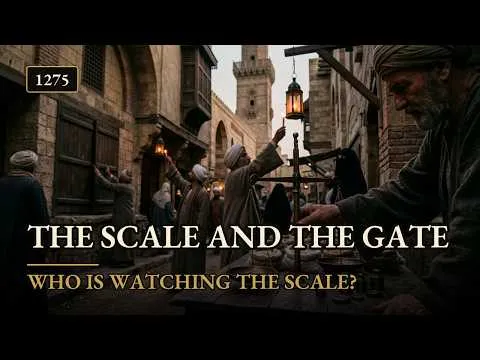 Watch the film
Long before sunrise in 1270s Hangzhou, butchers along the Imperial Way were already at work, rice barges were unloading at the northern bridges, and teahouse lamps were still burning from the night before. This week’s film starts there, with a simple idea: a market is not just a crowd. It is a rulebook covering who sells what, when, with which weights, and who is checking.
Six ways to run a market
The film sorts the markets along the Silk Road around 1275 into six forms. I want to be clear that the six are our own teaching device; no medieval writer divided things this way. The main witnesses: a merchant from Venice (Marco Polo), a friar from Flanders (William of Rubruck), and the handbooks written for market inspectors.
The first form is the bazaar of the Islamic world: covered streets with doors at either end, sellers grouped by trade, the costliest goods near the Friday mosque, and a lockable hall, the qaysariyya, for jewels, perfume and fine cloth. Over it stood the muhtasib, the inspector who checked weights, prices and food. A handbook tied to Tinnis, an Egyptian port abandoned in the 1220s, lists the tricks he watched for: flour padded with chickpea or barley, honey thinned with molasses, vegetable dishes sold as meat. No one can date it with confidence, and it borrows heavily from an earlier manual written in Syria. Most surviving market buildings in the region are from the 1500s or later, so the thirteenth-century picture is partly a reconstruction.
The second is the Chinese guild street. Tang Chang’an around 750 was carved into over a hundred walled wards, with commerce officially penned into two markets. Under the Song that broke open: in 965 night markets were allowed at Kaifeng, and by the mid-eleventh century the curfew had ended and shopfronts opened onto the street. Hangzhou in the 1270s was the open city at its fullest, with more than a dozen big specialized markets and nearly two hundred shops selling only salted fish. Polo speaks of ten great squares drawing forty or fifty thousand people on market days, but those are a traveler’s guesses, and the historian Jacques Gernet notes that Polo’s locations don’t match the Chinese records. The guilds stood behind the stalls, and the state used them to requisition goods and labor.
Gates, fairs and foreign quarters
The third form belonged to the Mongols. When Rubruck reached Karakorum in 1254 he found a mud wall with four gates, each with its own market: grain at the east, sheep and goats at the west, oxen and carts at the south, horses at the north. The khans’ merchant partners, the ortoq, traded with royal silver and used the official relay stations, and Chinese critics resented their privileges and their high-interest loans. Goods were taxed at city gates and stamped with a seal, at rates that are hard to pin down. In Iran and Anatolia, caravanserais were spaced roughly a day’s travel apart.
The fourth form paired the fair with the fondaco. Champagne’s counts held six fairs each year, spread over four towns, each opening with days of setting up and closing with days of settling accounts, while Italian money-changers cleared debts at their tables. Why the fairs declined is argued: the French crown absorbed Champagne in the 1280s, Genoese ships reached Bruges by sea in 1277, yet tax records seem to peak only in 1296. In the east, Italians lived in walled compounds and quarters: Genoa at Galata from 1267, Venice with its own weights after 1268, Genoa at Caffa with the blessing of the Golden Horde. Caffa also traded captives toward Constantinople, Egypt and Italy, and the records treat that cruelty as routine business.
Calendars and harbors
The fifth form kept time. Many Japanese markets gathered on set days, roughly thrice monthly, beside temple gates and at fords and bridges, and place names like Yokkaichi, the fourth-day market, still remember them. A picture scroll completed in 1299 depicts a market at Fukuoka in Bizen province, a riverside town not to be confused with the Fukuoka of Kyushu. In Kamakura the shogunate designated seven places for markets in 1251, a number that had grown to nine by 1265. Hakata had had a Chinese merchant quarter since around 1100, though how far it had declined by the 1270s remains debated.
The sixth form was the port with its customs house. According to Polo, traders from Kish, Hormuz and Aden sent horses by sea to the ruler of Maabar, in the southeast of India, who wanted over two thousand a year. At Zayton, by his account, the khan’s duty was a tenth of imports, and shipowners charged freight of 30 to 44 percent.
What ties the six together is the question in the film’s title. Wherever goods changed hands, someone had to decide whether the weights were honest, and someone had to be watching.
The film has the pictures and the map; the sources below have the details, and the arguments.
Sources
- Gernet, “Daily Life in China on the Eve of the Mongol Invasion” (Hangzhou’s markets, guilds, night trade and rice supply)
- Wikipedia, “Hangzhou” (population estimates; Polo’s exaggerations)
- Marco Polo, on Kinsay, Fordham Medieval Sourcebook excerpt (the ten squares and their crowds)
- Marco Polo, Yule and Cordier edition, vol. 2 (Maabar and the horse trade)
- Marco Polo, Yule and Cordier edition, vol. 2, p. 285, Digital Silk Road (Zayton’s duty and freight)
- Wikipedia, “Souq” and “Qaysariyya” (covered streets, locked markets)
- Wikipedia, “Muhtasib” (the market inspector and his punishments)
- Hill Museum & Manuscript Library, “The Hard Work of a Market Inspector” (the Tinnis manual on food fraud)
- Ahmed (2019), on brokers and auctioneers in Islamic Egypt (the papyri)
- Wikipedia, “Chang’an” (the walled wards and two markets)
- Hangzhou culture and tourism bureau, on Song night markets (the edict of 965)
- Wikipedia, “Society of the Song dynasty” (the end of the curfew)
- William of Rubruck, via Silk Road Seattle (Karakorum’s wall, gates and quarters, 1254)
- Wikipedia, “Ortogh” (the khans’ merchant partners; the office of 1268)
- Wikipedia, “Tamga” (the commercial tax and its seal)
- Encyclopaedia Iranica, “Bukhara iii” (1220, 1276, Masud Beg)
- Wikipedia, “Caravanserai” (spacing and layout)
- Wikipedia, “Champagne fairs” (the six fairs, the safe conduct of 1209, the decline debate)
- Wikipedia, “Galata” and “Byzantine–Venetian treaty of 1268” (the Italian quarters at Constantinople)
- Wikipedia, “Genoese slave trade” (Caffa’s captive trade)
- Pelikan (2023), Transmediterranean History, on the Mamluk–Venetian treaty of 1254
- Wikipedia, “Alexandria” (funduqs, consuls, customs and auctions)
- Kotobank, “Sansai-ichi” (Japan’s thrice-monthly markets; Kamakura’s market sites, 1251 and 1265)
- Wikipedia, “Ippen Shōnin Eden” (the scroll of 1299)
- Samurai Archives, “Hakata” (the Chinese quarter and its decline)
This letter was drafted with AI assistance from the film’s researched script and its source notes. The sources are listed above; corrections are welcome and noted on the page. Send a correction