Where the Year Turns
Maragha, Dadu, Dengfeng and the astronomers of two Mongol khans, 1259 to 1281
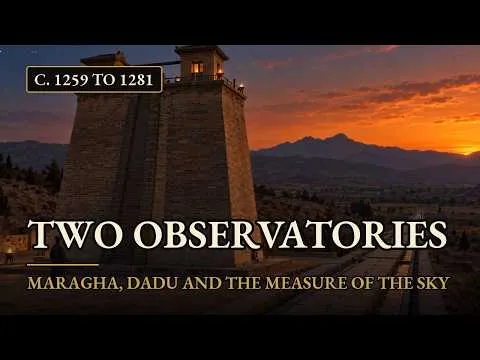 Watch the film
In the hills of central China there is a brick tower with a long stone groove running north from its foot. It looks like a monument, but it is a measuring tool, and this week’s film starts there, at noon on a winter solstice around 1280.
A shadow you can read
Chinese astronomers had long found the turn of the year by measuring the noon shadow of a post. The trouble is that a shadow’s edge is soft. At Dengfeng the builders raised the post into a tower: a horizontal bar set high in a window, said in Chinese records to stand forty chi up, five times the height of the old gnomons. Below it a stone scale runs about thirty-one meters. To sharpen the blur, an observer slid a copper sheet pierced with a hole of about two millimeters along the scale until the bar’s image split the spot of sunlight in two. The sources disagree on whether the tower went up in 1276 or 1279, but it still stands.
It was built for Kublai Khan, who wanted a new calendar. Less than twenty years earlier his brother Hulagu had begun a very different observatory in Persia. The film tells both stories together, and I found that the pairing changes how each one looks.
The hill at Maragha
In 1256 Hulagu’s army took the fortress of Alamut, and among the scholars there was Nasir al-Din Tusi, then in his fifties. Whether he came out a captive or a willing recruit is still debated. After Baghdad fell in 1258 he was given charge of religious endowments, or waqfs, and he persuaded Hulagu that the old star tables had drifted some two and a half centuries out of date. The result, from 1259, was an observatory on a hill at Maragha, paid for out of endowment income. One modern summary calls it the first observatory funded that way, and historians often credit the endowment with keeping it alive after Hulagu died in 1265. (There is also a colorful story about Tusi rolling a cauldron down the hill to make a point about fear and knowledge. It is late, and we tell it in the film only as a story.)
Excavators in 1972 traced the site: a flat hilltop about four hundred meters long, with a round central tower, instrument platforms, a casting workshop, a school and a library. The staff came from far away. Al-Urdi, from Damascus, built the instruments and the water supply. Al-Maghribi came from al-Andalus and kept an observation notebook from 1262 to 1274. The Syriac scholar Bar Hebraeus visited often and died there in 1286.
The plan was twelve years of planetary watching, a full circuit of Jupiter. Tusi’s Persian tables appeared soon after 1270, but Benno van Dalen thinks they did not yet include those results, though some older accounts say they did. They did include something unexpected: a Chinese-Uyghur calendar, with months starting at the new moon and years named for twelve animals. Two writers mention a Chinese scholar at Maragha, whose name survives only through Persian spellings as Fu Mengchi. Van Dalen thinks he was probably the main source, and that the calendar descended from the Jin dynasty’s, not Kublai’s. If so, one man carried a whole system west.
Two bureaus in Dadu
Traffic ran the other way too. Jamal al-Din, an astronomer from the Bukhara region, brought Kublai an Islamic calendar in 1267, with models or drawings of seven instruments (whether they were real objects is disputed), including the first earth globe in Chinese records. In 1271 Kublai gave him an Islamic Astronomical Bureau of about forty people, with Ptolemy and Euclid on its shelves. It did real work, remeasuring stars and planets in a Persian table book that survives mainly in a Chinese translation of 1383. Yet Shi Yunli finds no sign that its staff talked with their Chinese counterparts.
The Chinese bureau, set up in 1278 or 1279, was larger and, by Nathan Sivin’s reckoning, the costliest reform of its kind. Wang Xun ran the calculations and Guo Shoujing, a water engineer born in 1231, ran the observations, with teams at twenty-seven places across the empire. Their calendar took effect in 1281 with a year of 365.2425 days, a figure an earlier calendar of 1198 had already used. Europe would reach the same number in 1582.
What crossed, and what did not
This is the part that surprised me. With two observatories under one family of rulers, you would expect a flood of borrowing. The specialists find a trickle. People crossed, and with them a calendar going west and instrument designs going east. But van Dalen finds no Islamic tables inside Guo’s calendar, and Sivin finds no Islamic manual translated in the period. A few of Guo’s instruments resemble Islamic ones, and scholars have argued both ways; whether his eclipse method owes anything to Islamic geometry is still open.
Maragha had gone quiet by the early 1300s. Guo’s calendar served China for more than three centuries, and the tower at Dengfeng still catches the sun.
The film puts the tower, the hill and the people on screen; the sources behind each claim are below if you want to dig further.
Sources
- Wikipedia, “Gaocheng Astronomical Observatory” (the Dengfeng tower, the 40-chi bar and the stone scale)
- Astronomical Heritage (UNESCO/IAU), “Dengfeng observatory, China” (the tower and its dates)
- Ng Say Tiong and Helmer Aslaksen, “Calendars, Interpolation, Gnomons and Armillary Spheres in the Work of Guo Shoujing” (the pinhole sheet; Yuan Shi passages)
- Wikipedia, “Maragheh observatory” (the 1259 founding, the hill, the 1972 excavation)
- Mediterranea (Universidad de Córdoba), article on the Maragha observatory and its waqf funding
- Wikipedia, “Nasir al-Din al-Tusi” (Alamut, the waqfs, his death in Baghdad)
- F. J. Ragep, “Ṭūsī, Naṣīr al-Dīn,” Biographical Encyclopedia of Astronomers (prisoner or guest)
- MacTutor History of Mathematics, “Nasir al-Din al-Tusi” (life and work)
- Wikipedia, “Zij-i Ilkhani” (the Ilkhanic Tables)
- Wikipedia, “Tusi couple” (older than the observatory)
- Wikipedia, “Mu’ayyad al-Din al-Urdi” (instruments and water supply)
- Wikipedia, “Muhyi al-Din al-Maghribi” (the observation notebook, 1262 to 1274)
- Wikipedia, “Barhebraeus” (his visits to Maragha and death there in 1286)
- Benno van Dalen, “Islamic and Chinese Astronomy under the Mongols: a Little-Known Case of Transmission” (Fu Mengchi, the Chinese-Uyghur calendar, what crossed)
- Benno van Dalen, “Zhamaluding,” Biographical Encyclopedia of Astronomers (Jamal al-Din, the bureau, the survey)
- Wikipedia, “Jamal ad-Din Bukhari” (the seven instruments of 1267)
- Shi Yunli, “Islamic Astronomy in the Service of Yuan and Ming Monarchs” (two bureaus that did not talk)
- MAA review of Nathan Sivin, “Granting the Seasons” (the reform of 1280, its staff and cost)
- Biographical Encyclopedia of Astronomers, “Guo Shoujing” (instruments, stations, the Shoushi calendar)
- MacTutor History of Mathematics, “Guo Shoujing” (life, canals and water clocks)
- Wikipedia, “Guo Shoujing” (the simplified armillary and its Nanjing copy)
- Wikipedia, “Tropical year” and “Gregorian calendar” (comparing the year lengths)
This letter was drafted with AI assistance from the film’s researched script and its source notes. The sources are listed above; corrections are welcome and noted on the page. Send a correction