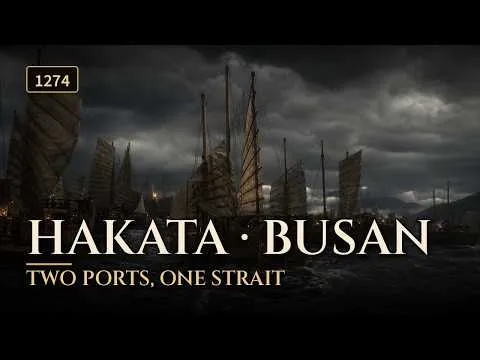
 Watch the film
Every night a ferry leaves Busan, crosses about two hundred kilometers of the Korea Strait, and comes into Hakata Bay at dawn. Today both shores are big ports. In 1270 they were nothing alike, and this week’s film is about how a war tied them together.
A door to the continent
Hakata, now part of Fukuoka, had been Japan’s front door for centuries. From the 600s, envoys from Tang China and the Korean kingdom of Silla stayed in a guesthouse on its shore before going on to the capital. When the guesthouse burned in 1047, private merchants took over its work. By around 1100 Chinese traders had their own quarter in Hakata, the Tōbō, with hundreds of households.
Two stories show how mixed the town was. In 1195 the monk Eisai founded Shōfuku-ji, often called Japan’s first full Zen temple, on the site of a chapel the Chinese residents had built. And in the 1230s a Hangzhou merchant named Xie Guoming, settled in Hakata with a Japanese wife, took in the monk Enni and helped buy land for another temple, Jōten-ji. The next year they shipped about a thousand logs back to Hangzhou to rebuild a burned monastery.
The ground under the modern city keeps the evidence: sulfur for export, and heaps of pottery from China, Korea and Southeast Asia. In 2017 more than two thousand of those pieces were designated an Important Cultural Property. No traveler described Hakata in 1270, and no population figure survives, but it was plainly a busy, international port.
A quiet county
Across the strait, the Busan coast was not a port at all. It was Dongnae, a county of hills, rice fields and fishing coves, and I found no source describing a harbor there in 1270.
The kingdom around it, Goryeo, had fought the Mongols for nearly thirty years before making peace on their terms in 1259. In 1270 the court went back to the mainland. Some soldiers refused and held out in the southern islands until 1273. Meanwhile Kublai Khan had sent envoys to Japan six times between 1266 and 1273, demanding submission. Japan sent them all away, and Kublai turned to Goryeo for ships.
Korean accounts speak of some nine hundred ships, about three hundred of them large, built within months by tens of thousands of workers. The Mongols are said to have paid in paper money. The fleet gathered at Hapo, today’s Masan, about fifty kilometers from Busan.
1274 and 1281
In autumn 1274 the fleet struck Tsushima and Iki, then landed at Hakata in November. The outnumbered samurai of Kyushu fell back, and the great Hakozaki Shrine burned. Then the invaders returned to their ships. Whether a storm hit them that night is uncertain: some historians doubt it and think the commanders simply judged the raid enough. Korean records say more than thirteen thousand of the men who sailed never came home.
The shogunate expected a second attempt. From 1276 every landowner in Kyushu built a share of a stone wall around Hakata Bay, in proportion to his rice fields: about twenty kilometers long and two to three meters high, sheer on the sea side.
Kublai came back in 1281 with two fleets, one from Korea and a much larger one from southern China. The records give about 140,000 men, a figure historians think too high. This time the wall held. The invaders could not land at Hakata, and Japanese raiders rowed out at night to attack the anchored ships. In mid-August a typhoon wrecked the southern fleet off Takashima, where divers have since found stone anchors, timbers and a seal that may have belonged to a Mongol commander. The Japanese called it kamikaze, the divine wind. How much of the victory belongs to the weather, and how much to the wall and the people who built it, is still argued.
What came after
The wall stayed, and so did the trade. In 1293 a samurai named Takezaki Suenaga, who had fought both invasions, had his deeds painted on scrolls to press his claim for a reward. Around 1323 a trading ship from Ningbo bound for Hakata sank off Korea with more than twenty thousand pieces of pottery and twenty-eight tonnes of Chinese coins aboard.
Busan’s rise came later. In the early 1400s Korea let Japanese traders settle in an enclave beside its harbor, and in 1876 Busan became Korea’s first international port. Of the wall at Hakata, only grassy fragments remain in seaside parks, and the morning ferry from Busan still comes in past them.
If you only have ten minutes, watch the film. If you want to check any of this, every source I used is listed below.
Sources
- Wikipedia, “Mongol invasions of Japan” (fleet sizes, envoys, Korean losses from the Goryeosa)
- Wikipedia, “Battle of Bun’ei” (the 1274 landing and the storm question)
- Wikipedia, “Battle of Kōan” (1281, night raids on the anchored fleet)
- Wikipedia, “Genkō Bōrui” (the wall at Hakata Bay: begun 1276, about 20 km)
- Wikipedia, “Goryeo under Mongol rule” (the 1259 peace; ships paid in paper money)
- Wikipedia, “Sambyeolcho Rebellion” (1270 to 1273)
- Wikipedia, “Hakata Site” (sulfur, imported ceramics, the 2017 designation)
- Wikipedia, “Shōfuku-ji (Fukuoka)” (Eisai, 1195)
- Wikipedia, “Jōten-ji” (Enni and the Hangzhou merchant Xie Guoming)
- Wikipedia, “Hakozaki Shrine” (burned in 1274)
- Wikipedia, “Mōko Shūrai Ekotoba” (Takezaki Suenaga’s scrolls, 1293)
- Wikipedia, “Shinan ship” (c. 1323, Ningbo to Hakata)
- Wikipedia, “History of Busan” (Dongnae county; the waegwan; 1876)
- Wikipedia, “Hakata Gion Yamakasa” (the 1241 tradition)
- nippon.com, “The Battle of Bun’ei” and “Ships on the Seabed” (the 1274 retreat; the Takashima finds)
- World History Encyclopedia, on the Hakata Bay wall and Suenaga’s scrolls
- Zenodo, “Buddhist Traders in the Chinese Quarter in Hakata” (the Tōbō, c. 1100 to 1300)
- Hankyung and Asia Economy (Korean press), on the Goryeo shipbuilding of 1274
- Busan Metropolitan City, container statistics, 2024
- Fukuoka Now, on the Fukuoka and Hakata names (1600, 1889)
This letter was drafted with AI assistance from the film’s researched script and its source notes. The sources are listed above; corrections are welcome and noted on the page. Send a correction