The Unpaid Victory
Warriors, shrines and the fall of the Kamakura shogunate, 1281 to 1333
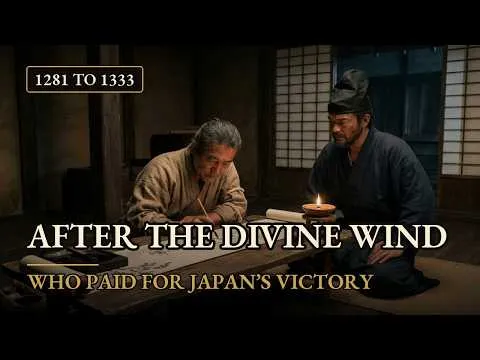 Watch the film
Late in Takezaki Suenaga’s picture scrolls comes a scene in Kamakura: the Kyushu warrior pleading his case before Adachi Yasumori, the great official who heard him. A note in the scrolls gives the year 1293. By then Yasumori had been dead for eight years. This week’s film starts from that odd detail and follows a question the battle stories tend to skip. Once the Mongol fleets were gone, who actually got paid?
A war with nothing to share out
Suenaga was the exception. He rode to Kamakura himself, found an official willing to vouch for his service, and was rewarded. His scrolls thank that official, and some Japanese scholars think they were also meant as a prayer for Yasumori’s soul.
For most warriors it went differently, and the system itself was to blame. A samurai fought for a reward in land, usually land taken from a beaten enemy. After 1274 the shogunate did honor more than a hundred and twenty of its direct vassals, the gokenin. After 1281 there was nothing to hand out: the invaders had held no Japanese soil, and they had gone.
The costs kept coming anyway. Men paid for their own retainers, horses and armor, and many borrowed against their land to do it. Kublai ordered troops gathered in Korea for a third attempt in 1284 and did not call it off until early 1286, and coastal guard duty lasted as long as the Kamakura regime did. The film shows the roster: Kyushu’s nine provinces rotating through four three-month watches, year after year. And every reward depended on paperwork. An official had to confirm a man’s deeds, and after 1274 that job fell to Yasumori.
The gods send a bill
Temples and shrines had been ordered to pray for victory, and once the fleets were gone many argued that their prayers had won it. One Japanese account says their petitions were written like soldiers’ service reports, listing the gods’ deeds. Takeo Shrine in Hizen, which got nothing, claimed that in 1274 a whistling arrow had shot out of the shrine toward the enemy fleet, and that in 1281 a purple banner had done the same.
Land was the currency again. Beginning in the 1280s, decrees told buyers and creditors in Kyushu to hand former shrine estates back free of charge, with the great shrines of Usa and Ise first in line, and the orders kept coming until 1312. Part of that land now belonged to gokenin, and by one account they too were expected to give it up. When the shogunate’s office at Hakata enforced the law again in 1312, local vassals pushed back hard. The gods’ reward, in other words, may partly have come out of the pockets of warriors still waiting for their own. The court paid in rank: the wind shrines at Ise were promoted in 1293, and the historian Kawai Atsushi notes that Hakozaki and Suwa were honored for their supposed help.
Kamakura turns on itself
The men who might have settled these bills fought one another instead. The regent Hōjō Tokimune died in April 1284, aged thirty-two, and his twelve-year-old son Sadatoki succeeded him. Yasumori, related to the boy through his mother, drove through a thirty-eight-article code that year, meant to give shrines back their land, enroll Kyushu landholders as gokenin, and curb the men who served the Hōjō family directly. Those men had a champion: Taira no Yoritsuna, steward of the Hōjō household.
In the winter of 1285 Yoritsuna declared Yasumori a rebel and struck. More than five hundred people died, the Adachi main line was destroyed, and the killing spread to Kyushu. Historians still argue about the cause, and the treason charge may have been invented. Yoritsuna dominated the regime until 1293, when Sadatoki’s men attacked him in the chaos after a great earthquake and he took his own life.
In 1297 Sadatoki tried to rescue his vassals with a debt-relief edict, a tokusei. It banned gokenin from selling or pawning land and let them recover land already sold, with some exceptions. In 1298 the ban was lifted, though the right to recover land stayed. Lenders pulled back, and buyers began writing clauses into deeds against any future edict. Historians give several reasons for the vassals’ debts: the invasions, inheritances split among all the heirs, and a spreading money economy, probably working together.
Two thrones and an ending
Kyoto had its own quarrel. The retired emperor Go-Saga died in 1272 without settling who should lead the court, and two lines descended from his sons Go-Fukakusa and Kameyama competed for the throne, with Kamakura as umpire. Go-Daigo, who came to the throne after talks between the lines broke down in 1317, wanted no umpire. Plots came to light in 1324 and 1331, and in 1332 he was exiled to the Oki Islands. In 1333 he escaped and rallied warriors. Kamakura’s general Ashikaga Takauji changed sides, and Nitta Yoshisada marched on Kamakura itself. According to a war tale written later, roughly eight hundred seventy Hōjō kin and followers took their own lives at the temple of Tōshō-ji.
Three days later the Shōni, Ōtomo and Shimazu, houses once posted against the Mongols, attacked the shogunate’s office at Hakata. Its chief died along with two or three hundred relatives; the counts differ. Historians do not blame the Mongols alone for the fall, but the unpaid bill of 1281 runs through the whole story.
The film has the scrolls, the maps and the timeline; the sources below let you follow any thread further.
Sources
- Wikipedia, “Mōko Shūrai Ekotoba” (Takezaki Suenaga’s scrolls and the 1293 note)
- Wikipedia, “Takezaki Suenaga” (his ride to Kamakura and his reward)
- Japanese Wikipedia, “Takezaki Suenaga” (竹崎季長) (the scrolls as thanks to Yasumori)
- Japanese Wikipedia, “Adachi Yasumori” (安達泰盛) (rewards, the code of 1284)
- Wikipedia, “Mongol invasions of Japan” (no Japanese land to seize after 1281)
- Wikipedia, “Gokenin” (the shogun’s direct vassals and their costs)
- Japanese Wikipedia, “Kōan campaign” (弘安の役) (the rewards of 1274; the third attempt called off; guard duty)
- Japanese Wikipedia, “Genkō” (元寇) (the shrines’ petitions and Takeo Shrine)
- Japanese Wikipedia, “Shinryō kōgyō” (神領興行) (the shrine-land decrees, 1284 to 1312)
- Japanese Wikipedia, “Kaze no Miya” (風宮) (the Ise wind shrines raised in 1293)
- nippon.com, Kawai Atsushi on the Mongol invasions (Hakozaki and Suwa honored; the cost to the shogunate)
- Wikipedia, “Hōjō Tokimune” (his death in 1284)
- Wikipedia, “Hōjō Sadatoki” (regent at twelve; the fall of Yoritsuna; the edict of 1297)
- Japanese Wikipedia, “Shimotsuki Incident” (霜月騒動) (1285: the dead and the disputed cause)
- Japanese Wikipedia, “Taira no Yoritsuna” (平頼綱) (the household steward)
- Wikipedia, “1293 Kamakura earthquake”
- Japanese Wikipedia, “Einin debt-relief edict” (永仁の徳政令) (1297 and its repeal in 1298)
- Kotobank, “Einin no tokusei-rei” (the three parts of the edict)
- Japanese Wikipedia, “Ryōtō tetsuritsu” (両統迭立) (the two imperial lines and their turns)
- Wikipedia, “Emperor Go-Daigo” (his plots, exile and return)
- Wikipedia, “Siege of Kamakura (1333)” (Nitta Yoshisada and Tōshō-ji)
- Japanese Wikipedia, “Chinzei Tandai” (鎮西探題) (the Hakata office and its end in 1333)
This letter was drafted with AI assistance from the film’s researched script and its source notes. The sources are listed above; corrections are welcome and noted on the page. Send a correction