The Man Between
Cho In-gyu, the friars’ letters and the interpreters of the Mongol world, c. 1250 to 1300
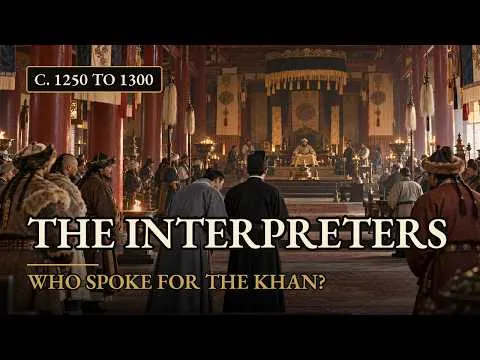 Watch the film
Every message that crossed the Mongol empire passed through someone standing in the middle: a person who heard one language and spoke another, or read one script and wrote a second. The chroniclers seldom named them. This week’s film goes looking for a few, between about 1250 and 1300.
A Goryeo man at Kublai’s court
The film begins with Cho In-gyu, born in 1237 in Sangwon, a town close to the line where Goryeo and the Mongol armies faced each other. Korean sources say the court picked young men to learn Mongolian, and that Cho was one of them and worked at it day and night. In 1269 he went with the crown prince, the future King Chungnyeol, to Kublai’s court as his interpreter. Nobody described that day, so the opening scene is imagined around the bare fact of the visit.
The skill carried him far. He helped arrange the prince’s marriage to a daughter of Kublai, rose through the offices of state, and in the 1290s became chancellor. Then it came apart. In 1298 the new king’s Mongol wife accused his other wife, Cho’s daughter, of cursing her, and took the charge to the Yuan court. The family was arrested and Cho was exiled far to the west. He came home about six years later.
One letter, four languages
The clearest picture of the work comes from the friar John of Plano Carpini, sent east by Pope Innocent IV in 1245 with Benedict the Pole as his interpreter. At the first Mongol camp, Carpini says, no one could make sense of the pope’s letter. At Batu’s camp in April 1246 it was rendered into Russian, Saracen and Mongol, and Batu read the Mongol text. (“Saracen” meant Arabic script; which language it carried is still debated.) At Güyük’s camp the friars wrote out their business and then repeated it aloud through interpreters, one of them a knight named Temer.
The khan’s reply, in November 1246, was handled with real care. His secretaries read it to the friars word for word, the friars put it into Latin, and the secretaries then had them explain each phrase and compared the two versions. Offered a copy in Saracen script as well, the friars said nobody at home could read it, and carried back the Mongol original with their Latin.
Forty years later the traffic ran the other way. A Latin letter from the Ilkhan Arghun to the pope, dated May 1285, survives in the papal register; the scholar Jean-Baptiste Chabot judged that its translators knew Mongol far better than Latin. It names two interpreters, Ise and Ugeto. In 1289 Arghun wrote to Philip IV of France in Mongol, under a red seal in Chinese characters, and a Genoese named Buscarello carried it with a memorandum in French.
Offices, schools and slips
The Mongols started with whoever could write. Morris Rossabi notes that Chinggis Khan used captured Uyghurs and Khitans as clerks, and that under Mongol rule speaking and writing became separate jobs with separate titles. In 1272 the Yuan founded an Interpreters Institute, closed it in 1288 (perhaps out of suspicion of its Muslim interpreters) and reopened it in 1292. Goryeo set up its own school, the Tongmun-gwan, in 1276, after an official complained that interpreters were poorly taught and sometimes bent messages for profit. A Korean encyclopedia doubts it changed much, since men like Cho did most of the real work.
Mistakes were part of the story. William of Rubruck, traveling in 1253, had an interpreter he calls Homo Dei; once Rubruck learned some Mongol, he found the man often said something quite different, and chose to keep quiet. Rubruck also suspected the Armenian translators of King Louis IX’s letter of slipping in a request for troops that Louis never made. And when a modern journal asked five experts to read one Persian-script inscription on a travel tablet, it got five readings.
Taken, born between, and lost
Some were captured into the job. The Armenian scholar Kirakos was seized in 1236 and kept for reading and writing letters; his captors would not ransom him, so he escaped that night, and later wrote down about fifty Mongol words. Isa, whom the Yuan history calls a man of the far west, served Güyük and then Kublai, and was sent to Arghun and back. Many historians think he is the Ise of the 1285 letter, though that rests on a match of names. Rabban Sauma’s journey west in 1287 included two Italian interpreters who may be the letter’s Thomas and Ugeto.
Much stays dim. I found no wage list for these years, only scraps. The Codex Cumanicus, a Latin, Persian and Cuman word book, carries the date 1303 but is a later copy. Scholars still argue whether Persian, Turkic or no single language bound the empire together. Rossabi suspects there was none, which would make the people in this film matter even more.
The film puts faces to a few of these voices; the sources below let you follow each one back to the page.
Sources
- Wikipedia, “Cho In’gyu” (born 1237 in Sangwon; interpreter in 1269; the royal marriage; the arrest of 1298)
- Encyclopedia of Korean Culture, “Cho In-gyu” (chosen to learn Mongolian; exile and return about six years later)
- Wikipedia, “Chungnyeol of Goryeo” (the prince who married Kublai’s daughter)
- John of Plano Carpini, Ystoria Mongalorum, excerpt at the University of Washington Silk Road site (the pope’s letter and the khan’s reply, 1245 to 1246)
- J.-B. Chabot, Histoire du patriarche Mar Jabalaha III et du moine Rabban Çauma (1895), Appendix I (Arghun’s Latin letter of 1285; Ise and Ugeto)
- Encyclopaedia Iranica, “Arghun Khan” (the embassy of 1289 and the Genoese Buscarello)
- Wikipedia, “Buscarello de Ghizolfi” (the Mongol letter of 1289, the French memorandum, the translation of 1305)
- Morris Rossabi, “Communications and ‘Communicators’ in the Yuan and Early Ming,” Journal of Chinese History (2025) (clerks under Chinggis; the Interpreters Institute; Xu Ting; the lingua franca question)
- Stephen G. Haw, “The Persian Language in Yuan-Dynasty China: A Reappraisal,” East Asian History 39 (2014) (the National Colleges; the five readings of a travel tablet; Turkic and Persian)
- Ji-won Kim, “The Korean Tradition of Translation,” Journal of Language & Translation 9 (2008) (the Tongmun-gwan of 1276)
- Encyclopedia of Korean Culture, “Tongmun-gwan” (Kim Gu’s proposal; why the school was founded; its doubtful effect)
- Wikipedia, “Bureau of Interpreters” (founded by King Chungnyeol in 1276)
- William of Rubruck, Itinerarium, trans. W. W. Rockhill (Hakluyt Society, 1900) (Homo Dei; Boucher’s household; the letter to Sartaq)
- Chinese Wikipedia, “Heida shilue” (Xu Ting’s embassy of 1235 to 1236)
- Kirakos Gandzakets’i, History of the Armenians, trans. Robert Bedrosian, chapters 24 and 32 (capture in 1236; the Mongol word list)
- Wikipedia, “Kirakos Gandzaketsi” (the capture with Vanakan)
- Yuan Shi, juan 134, biography of Aixue (Isa), on Wikisource (Fulin; languages, stars and medicine; the mission to Arghun)
- Wikipedia, “Isa Kelemechi” (the title Kelemechi)
- Wikipedia, “Rabban Bar Sauma” (Tommaso d’Anfossi and Ughetto, 1287)
- Encyclopaedia Iranica, “Codex Cumanicus” (Latin, Persian and Cuman; the 1303 date on a later copy)
This letter was drafted with AI assistance from the film’s researched script and its source notes. The sources are listed above; corrections are welcome and noted on the page. Send a correction