Horn, Sinew and Powder
Bows, armor, bombs and siege engines in the age of the Mongol invasions of Japan, c. 1250 to 1300
 Watch the film
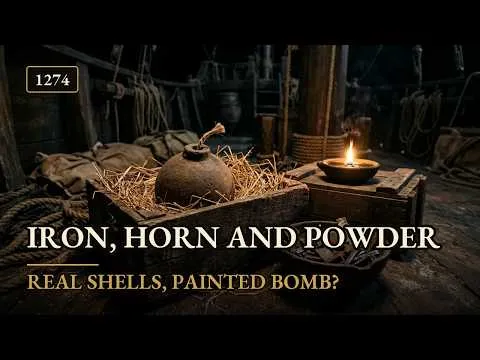
The most famous image of a bomb exploding in medieval Japan, on a samurai’s scroll, may have been painted some five centuries after the battle it shows. The bombs themselves were real, and divers have brought them up from the seabed. That gap between picture and object is the thread running through this week’s film about weapons from roughly 1250 to 1300.
The bow on the bench
The film opens on a bowyer’s workbench. A composite bow joins three materials: horn on the face toward the archer, which resists compression, sinew on the back, which resists stretching, and a wooden or bamboo core between, all bound with animal glue. Modern estimates suggest about a week of work and months of drying, and damp ruins the glue. An army that wanted many of these bows had to think well in advance.
Around 1247 the friar John of Plano Carpini described Mongol soldiers for the pope: two bows or one good one, three quivers, arrowheads sharpened on both edges with a file kept in the quiver, iron helmets, and horses protected by leather doubled or tripled and shaped to the body. Some men wore lamellar, small iron plates laced with leather and polished bright. How far and how hard those bows shot, no thirteenth-century record says. Modern reconstructions give about 150 meters for an aimed shot, and one worn inscription may record a single feat of about 500 meters, if it is read correctly.
The neighbors fought differently. The Song in China often relied more on crossbows than bows. Goryeo, the Korean kingdom, prized the bow above everything and kept crossbows for defending walls and laying ambushes. By the 1270s the Mongol army had absorbed soldiers and craftsmen from all of them.
Powder and engines
Gunpowder enters as a spear. Song defenders at De’an in 1132 used fire lances, tubes of powder on poles that, a century later, still threw flame only a few meters. In 1232, at the Jin capital Kaifeng, defenders lowered iron bombs on cords onto Mongol sappers digging under the walls. A Jin witness said one blast could kill several men. The city fell after about a year, and the Mongols kept the weapons and the people who made them.
At Baghdad in 1258 a corps of about a thousand engineers raised mounds for siege machines. In 1271 Kublai asked his kinsman in Persia for counterweight trebuchet experts, and two engineers, Ismail and Ala al-Din, came east. Such machines are credited with helping end the long siege of Xiangyang in 1273.
The wider world
The film steps west for context. At Ayn Jalut in 1260 a Mamluk army beat a Mongol force, by a feigned retreat and ambush according to Rashid al-Din. Some writers claim the Mamluks used hand cannon there; several historians reject that, since firm accounts of such guns in Egypt and Syria come about a century later. In Europe the crossbow was standard and some knights were already wearing plates inside their coats.
Hakata, 1274 and after
The Japanese warrior carried a tall laminated yumi with its grip set low, wore ō-yoroi made of lacquered scales laced with silk cord, and hung a tachi edge down. Japanese accounts describe the custom of riding out, calling one’s name and seeking a worthy opponent. A shrine text written some decades after 1274 says the invaders ignored all that, advancing in a mass to drums, while explosions frightened the horses.
Historians link those explosions to the tetsuhō, clay shells packed with powder and iron scraps. By 2003 divers off Takashima had recovered six from the wrecks of the second invasion in 1281, and X-rays showed powder and iron fragments inside. The famous scroll painted for Takezaki Suenaga, traditionally dated to 1293, does show a bomb bursting, but the historian Thomas Conlan argues that detail was added in the eighteenth century. So the shells are genuine evidence; the painted bomb is not an eyewitness view.
Who could afford what? Warriors paid for their own gear, and Suenaga sold horses and saddles to travel to Kamakura and plead for a reward. No price list from the century survives, and the film declines to guess. Nor did weapons decide the war alone: the wall at Hakata, the weather and the sea all mattered, and historians still weigh how much.
Watch the film to see the bench, the bow and the shells, then follow the sources below for the evidence behind each one.
Sources
- Wikipedia, “Mongol bow” and “Composite bow” (horn, sinew and glue; modern range estimates)
- De Re Militari, John of Plano Carpini on the Mongol soldier, c. 1247 (bows, quivers, files, iron and leather armor)
- Wikipedia, “Mongolian armour” (lamellar; mail called rare)
- Wikipedia, “Military of the Mongol Empire” (engineers and foreign troops)
- Wikipedia, “Crossbow” (Song ratios; European rates of shooting)
- Wikipedia, “Military of Goryeo” (the bow first, crossbows for defense)
- Wikipedia, “Fire lance” (De’an, 1132)
- Wikipedia, “Thunder crash bomb” (Kaifeng, 1232; the tetsuhō)
- Wikipedia, “Siege of Baghdad (1258)” (the engineer corps)
- Wikipedia, “Ismail (mangonel expert)” and “Trebuchet” (the engineers sent east in 1271)
- Wikipedia, “Battle of Xiangyang” (fell 1273)
- Wikipedia, “Battle of Ain Jalut” (1260; the hand cannon claim rejected)
- De Re Militari, Rashid al-Din on Ayn Jalut (the feigned retreat)
- Wikipedia, “Furusiyya” (Mamluk horsemanship; al-Rammah)
- Wikipedia, “Greek fire” and “Battle of Mansurah (1250)” (naphtha; Joinville’s fiery missile)
- Wikipedia, “Coat of plates” and “Battle of Falkirk” (European armor and archers, 1298)
- Wikipedia, “Yumi”, “Japanese armour” and “Tachi” (the samurai’s bow, ō-yoroi and sword)
- Wikipedia, “Japanese swordsmithing” (iron sand steel)
- nippon.com, “The Battle of Bun’ei” (the 1274 landing, the Hachiman text, the explosions)
- Wikipedia, “Mongol invasions of Japan” (Takashima shells; the wall; Conlan on the painted bomb)
- James Delgado, “Relics of the Kamikaze,” Archaeology (2003) (the Takashima shells, swords and armor)
- Wikipedia, “Mōko Shūrai Ekotoba” and “Takezaki Suenaga” (the scrolls and the later bomb)
- Wikipedia, “Genkō Bōrui” (the Hakata Bay wall)
This letter was drafted with AI assistance from the film’s researched script and its source notes. The sources are listed above; corrections are welcome and noted on the page. Send a correction