Four Scents from Four Corners
Ambergris, frankincense, musk and camphor between Arabia, Tibet, Sumatra and China, c. 1270 to 1290
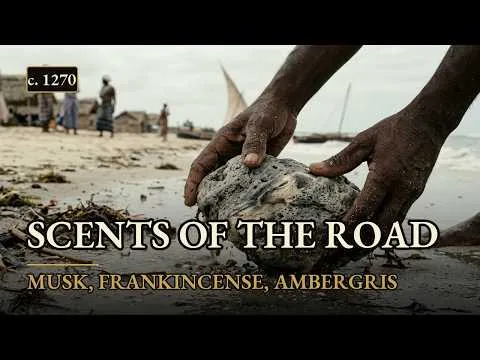 Watch the film
Silk gets the headlines, but some of the most valuable cargo on the medieval roads weighed almost nothing and was meant for the nose. This week’s film follows four scents of roughly 1270 to 1290: ambergris, frankincense, musk and camphor. Each began somewhere most of its buyers would never see.
Three guides, and a gray lump
The film leans on three witnesses. Zhao Rukuo was a Chinese customs official at Quanzhou who, around 1225, wrote down what foreign merchants told him. Marco Polo saw some of the places he describes and only heard about others, so his figures need a pinch of salt. And the Persian scholar Nasir al-Din Tusi, who died in 1274, recorded what camphor cost.
We open with ambergris, a waxy gray lump that washed up on the shores around the Horn of Africa. Zhao passes on an older claim that its smoke, burned with incense, rises in a column so steady you could cut it with scissors. Nobody in his day knew what it was. Chinese books called it dragon’s spittle, and Arab and Persian writers offered theories for centuries: a sea-floor truffle, an undersea spring of tar, hardened foam, the dung of some creature. Polo tied it to whales off Socotra, and modern science agrees that sperm whales produce it, though no one then could prove it. A tenth-century writer even says camels were trained to sniff it out on moonlit beaches.
Buyers judged it by color and smell, and perfumers blended it with musk into a rich salve. As for price, Persian books call it scarce and costly, but the film found no figure from the 1270s and, rightly, does not make one up.
Resin and the deer
Frankincense came from the southern Arabian coast, at places Zhao names as Mirbat, Shihr and Dhofar. Polo says the trees were tapped with a knife and wept a white resin; both he and Zhao name it for its milky color. Who did the gathering in the 1270s, no source we found says. A first-century Greek sailors’ guide claims it was slaves and condemned men, on a coast so unhealthy that many died.
Polo also reports that the prince at Shihr bought incense from his people at ten livres of gold the hundredweight and sold it on at sixty, a sixfold markup. That is his figure, and it came to him secondhand. Shipped east to Sumatra and then to China, the resin met Zhao’s own customs office, which sorted it into thirteen grades, from fingertip drops down to dust and sea-spoiled black lumps.
Musk came from the opposite direction: the high borderlands of western China and Tibet. Only adult male musk deer carry the scent gland, and the animal had to be killed to take it. Arabic writers praised Tibetan musk from the ninth century, and one historian argues that musk became the most important of all scents in the Islamic world. Its price invited fakery, with a little real musk stretched by other things. Polo knew the trade firsthand: in 1311 a Venetian court backed him against an agent who had sold half a pound of his musk without paying and returned the rest underweight.
Camphor and the cheaters
The fourth scent was camphor, crystals from a tall tree on Sumatra and Borneo. Zhao describes crews felling trees and splitting the logs to reach the camphor in the cracks. Polo claims the best Fansur camphor sold for its weight in gold, which his editor Henry Yule suspected was an exaggeration. Tusi’s prices are more sober: three hundred dinars a man for Fansur camphor against five for the processed kind. A sixtyfold gap is an invitation to cheat, so buyers melted samples in a glass flask; anything left behind meant a fake. Tusi also advised storing camphor sealed in a bottle with a few grains of barley.
Laid side by side, these numbers come from different markets and different writers. They are ratios, not a price list, and the film is clear about that.
Who lit the fire
The customers were everywhere. Frankincense burned in church censers. Muslim practice placed camphor in the last washing of the dead, and to smell of musk was to be thought an excellent person. At Kublai’s court, Polo says, people of every faith burned incense on the Khan’s birthday, each to his own god.
Whether anyone ever cut that column of ambergris smoke with scissors, I cannot tell you. But the story traveled as far as the lumps did.
The film puts all four scents on screen; the sources below are there if you want to dig deeper.
Sources
- Hirth and Rockhill, Chau Ju-kua (Zhao Rukuo’s Zhu Fan Zhi, c. 1225, in English) (ambergris on the beaches, the thirteen grades of frankincense, camphor gathering and grades)
- Wikipedia, “Zhao Rukuo” (the Quanzhou official and his book)
- Yule and Cordier, The Travels of Marco Polo, vol. 1, Project Gutenberg (musk at Sinju; incense at the Khan’s court)
- Yule and Cordier, The Travels of Marco Polo, vol. 2, Project Gutenberg (Dhofar and Shihr, ambergris off Socotra, camphor of Fansur, and Yule’s notes)
- McCrindle, The Commerce and Navigation of the Erythraean Sea, Project Gutenberg (the first-century incense coast)
- Wikipedia, “Frankincense” and “Incense” (the resin and its uses)
- Encyclopaedia Iranica, “ʿAnbar (ambergris)” (grading by color, ghaliya, Persian books on its price)
- Buquet, “De la pestilence à la fragrance,” Bulletin d’études orientales 64 (2016) (Arabic theories of where ambergris came from; Abu Zayd’s camels)
- Encyclopaedia Iranica, “Camphor” (Tusi’s prices, the melting test, storage with barley)
- Wikipedia, “Nasir al-Din al-Tusi” (the scholar of Maragha, died 1274)
- Encyclopaedia Iranica, “ʿAṭr (perfume)” (recipes and counterfeits)
- Akasoy and Yoeli-Tlalim, “Along the musk routes,” Asian Medicine 3 (2007), abstract (Tibetan musk in Arabic writing)
- University of Southern Indiana, “On the bookshelf: King explores the origins and trade of musk” (2017), on A. H. King, Scent from the Garden of Paradise
- Wikipedia, “Musk” and “Musk deer” (the gland of the adult male)
This letter was drafted with AI assistance from the film’s researched script and its source notes. The sources are listed above; corrections are welcome and noted on the page. Send a correction