A Bowl at the Door
Sufi lodges, their guests and their patrons, from Saladin’s Cairo (1173) to Ibn Battuta’s Anatolia (1332)
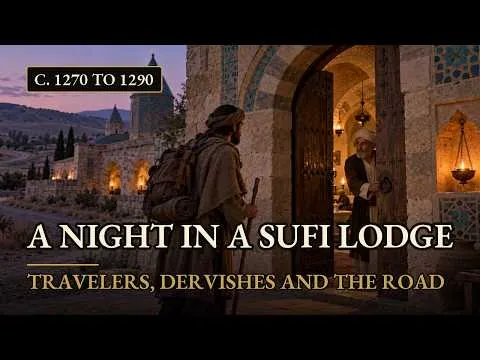 Watch the film
This week’s film starts with a man nobody recorded. We picture him on an Anatolian road around 1275, at dusk, with an empty purse, knocking at the door of a Sufi lodge. Everything that happens to him after the door opens is borrowed from people who did write things down, and the film is careful to say whose evidence it is using and from which year.
The rules of the house
The houses went by several names. Across the lands from Persia to Egypt the common word was khanqah. A ribat could be a lodge too, though in Syria the word drifted toward meaning a house for women. Zawiya belonged mostly to North Africa, and the Turkish tekke came later. Whatever the name, it was a place where a brotherhood lived, prayed and taught, and where a stranger could find a meal.
Our best guide to the etiquette is a manual written in Baghdad by Shihab al-Din Umar al-Suhrawardi, who died in 1234. The catch is that we read it through a Persian reworking made about a century later, so every rule reaches us secondhand. Still, the rules are striking. Guests were supposed to arrive before the afternoon, greet the house with prayer and handshakes, and keep quiet unless asked. Hosts were to welcome them, feed them something light, and let them rest. A newcomer was to stay put for three days; only after that could he ask to remain and take on a task. Even a guest who seemed unfit was fed and sent on kindly. The meal, in other words, came before the questions.
Not everyone at the door was honest. Sa’di, writing in 1258, tells of dervishes who let a stranger in a Sufi cloak join them, only to see him rob them and land the whole party in jail. Fifty years after our imagined night, Ibn Battuta found Cairo’s lodges running like small institutions: twice-daily bread and soup, seasonal clothing, a monthly allowance, and Thursday treats of sugar cakes and soap. We have nothing like that list for a small roadside house.
Who paid for the soup
Mostly, an endowment did. A donor set aside property as a waqf, and its income paid the cook and filled the pot. Saladin turned a former palace in Cairo into a lodge for outside Sufis in 1173. The Mamluk sultan Qalawun endowed a ribat in Jerusalem in 1282. On the Anatolian roads, the Seljuk sultans built about a hundred caravanserais. These were inns, not Sufi houses, but they too ran on pious gifts, and general accounts say many offered free food and lodging.
Women had their own houses. In Aleppo an inscription dates a ribat to 1237 or 1238, probably founded by the regent Dayfa Khatun, and it is said to have sheltered widows, older women and divorced women. In Cairo in 1285, a daughter of Sultan Baybars endowed one for a woman shaykh who already had a following in Damascus.
The night, and the voices
After dark came prayer and, in many houses, dhikr, the repetition of God’s name or a short phrase. Some lodges also held sama, listening to chanted verse, though scholars disagreed about it. The film is honest about the whirling dervishes: according to Turkey’s culture ministry, Konya’s ceremony had no fixed form while Rumi lived, and was shaped by his son and grandson and later generations.
Rumi is in the film, but as one voice in a crowded room. Alongside him are his Konya contemporary Qunawi, a pupil of Ibn Arabi; Sa’di in Shiraz; Suhrawardi’s order in Baghdad, which outlasted the caliphate; the Chishti shaykhs of the Punjab and Delhi; the wandering Qalandars with their shaved brows; and the craftsmen’s brotherhoods led by akhis, whose guesthouses Ibn Battuta enjoyed in 1332.
Shaykhs and khans
The Mongols are the backdrop. Najm al-Din Kubra died in 1221 when the Mongols took his city, after refusing to leave. His pupil Sayf al-Din Bakharzi lived on in Bukhara under Mongol rule for about forty years and is said to have had real influence. A later story credits him with converting the khan Berke, but a Persian historian of the time says Berke was raised a Muslim, so I would treat that story with care. Later still, a Mongol vizier in Tabriz paid a poet’s lodge a thousand dinars a year, and in Konya a Georgian princess helped pay for Rumi’s tomb, finished in 1274.
What stays with me is how little we hear from the cook, the doorkeeper or the women of the ribat. Their work is the reason the traveler walked away fed.
Watch the film for the full night, and use the sources below to follow any thread further.
Sources
- Suhrawardi, ʿAwārif al-maʿārif, in H. Wilberforce Clarke’s English of the later Persian version (Calcutta, 1891) (the rules for guests and hosts, the evening routine, the debate over sama)
- Wikipedia, “Shihab al-Din ʿUmar al-Suhrawardi” (the Baghdad author, died 1234; the title Shaykh al-Islam)
- Wikipedia, “Mahmud ibn Ali al-Qashani” (the Persian reworking, about a century later)
- Wikipedia, “Khanqah” (names for the lodge; Saladin’s Cairo house of 1173; endowments)
- Wikipedia, “Sufi lodge” (kitchens, guest rooms, patronage)
- Wikipedia, “Ribat” (the word’s shift to a house for women in Syria)
- Wikipedia, “Zawiya (institution)” (the North African usage)
- Wikipedia, “Khanqah al-Farafira” (the Aleppo women’s ribat, inscription of 1237 or 1238)
- Wikipedia, “Dayfa Khatun” (the probable founder in Aleppo)
- Women Builders of the Islamic World, entry for the Ribat al-Baghdadiyya, Cairo, 1285
- Wikipedia, “Ribat of Sultan al-Mansur Qalawun” (Jerusalem, 1282)
- Wikipedia, “Sultanate of Rum” (about a hundred Seljuk caravanserais)
- Saʿdi, Gulistan, James Ross’s English translation, Project Gutenberg (the thief in a dervish’s cloak; ten dervishes on one rug)
- Wikipedia, “Saadi Shirazi” (his travels, the Gulistan of 1258, his death in 1291 or 1292)
- Ibn Battuta, Rihla, Cairo section, Gibb translation, Internet Medieval Sourcebook (Cairo’s lodges about 1326)
- Ibn Battuta, Rihla, Anatolia sections, Gibb translation (Bursa and the akhis, 1332)
- Wikipedia, “Dhikr” and “Sama (Sufism)” (remembrance and listening)
- Turkish Ministry of Culture and Tourism, on the Mevlevi sema ceremony (no fixed rules in Rumi’s lifetime)
- Wikipedia, “Nizamuddin Auliya” (listening without instruments or dancing; his lodge near Delhi)
- Encyclopaedia Iranica, “Ganj-e Šakar, Farid-al-Din Masʿud” (Baba Farid at Ajodhan)
- Wikipedia, “Rumi”, “Sadr al-Din al-Qunawi” and “Ibn Arabi” (the Konya and Damascus voices)
- Wikipedia, “Jamal al-Din Saoji” (the Qalandars) and “Akhiya” (the craftsmen’s brotherhoods)
- Wikipedia, “Najmuddin Kubra” and “Sayf al-Din Bakharzi” (the Kubrawiyya under the Mongols)
- Wikipedia, “Berke” (the two accounts of his faith)
- Wikipedia, “Humam-i Tabrizi”, “Tekuder” and “Mevlana Museum” (Juvayni’s grant; Tegüder’s Sufis; Rumi’s tomb, 1274)
This letter was drafted with AI assistance from the film’s researched script and its source notes. The sources are listed above; corrections are welcome and noted on the page. Send a correction