The Patriarch Who Knew the Khans
Rabban Sauma, Markos and the Church of the East, from Khanbaliq to Maragha, about 1275 to 1317
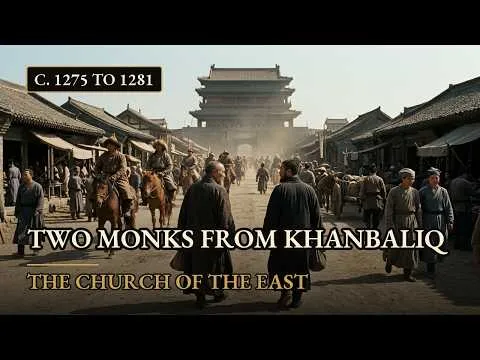 Watch the film
In November 1281 the bishops of a church at Baghdad consecrated a new patriarch, and he was an unlikely pick. Markos was in his middle thirties and had grown up among the Ongut, a Turkic people on the northern rim of China. According to his biography, he warned the electors that he was poorly schooled and could barely manage Syriac, the language his church prayed in. They chose him regardless, and he became Yahballaha III. This week’s film follows how he got there, and the teacher who brought him.
A church that followed the roads
The church he would lead used the name Church of the East for itself; outsiders labeled it Nestorian, after a fifth-century bishop it declined to condemn, though scholars now find that label misleading. Its patriarchs had been based at Baghdad for centuries, and its Syriac prayers, an old form of Aramaic, traveled with its clergy deep into Asia.
There was a metropolitan, a senior bishop in charge of a province, at Samarkand by 1018, and a province for Kashgar from the late twelfth century. In the Ili valley near Almaliq, a cemetery still holds stones cut in Syriac script, largely from the 1200s and 1300s. Much farther east, a mission led by Alopen had reached China in 635; a stone tablet set up at Chang’an in 781 recorded it, and was buried in 845. Under the Mongols the church returned to China and flourished, though mostly among foreigners. By the 1200s it had two provinces in the north, one covering the Ongut lands where the Yellow River makes its great northern loop.
It also had friends at court. Chroniclers say the Keraites of the steppe became Christian after a khan who got lost in a blizzard around 1007 promised to be baptized. Genghis Khan broke them in 1203 but married into their ruling family. A Keraite princess of this church, Sorghaghtani Beki, wed his son Tolui and raised four sons who all rose to power, Möngke, Kublai and Hulagu among them. Hulagu’s wife, Doquz Khatun, was a Christian Keraite too. Still, a modern survey cautions that Christianity never loomed large across the empire overall.
The hermit and the pupil
Rabban Sauma came into the world in the 1220s, in or near present-day Beijing, then the Jin capital, Zhongdu. Chinese accounts call his family Ongut; the chronicler Bar Hebraeus describes him as a Uyghur. He took up a monk’s life, lived seven years shut in a cell, then moved to a cave a day from the city, where people came to hear him. Markos, an archdeacon’s youngest son from the Ongut town of Koshang, traveled fifteen days to find him. Sauma tried to put him off, then accepted him.
Around 1275 the pair set out to pray at Jerusalem. They crossed Tangut country, then skirted the great desert to Khotan, a two-month stretch with only eight days of sweet water. Fighting raged around Khotan, Kashgar had been plundered, and they passed the prince Kaidu’s camp in the Talas valley before reaching Khorasan. The patriarch Denha gave them a warm welcome at Maragha, in northwestern Persia.
Jerusalem never happened. Trying a route through Armenia, they learned in Georgia that murders and robberies had shut the way, and they gave up. Denha named Markos metropolitan of Katai and Ong, and his new name, Yahballaha, was picked by lot from slips laid on the altar. Fighting closed the way home, so the two waited about two years at a monastery near Mosul. Then, early in 1281, Denha died.
Why the outsider won
The electors (bishops, nobles and physicians) wanted Markos for a practical reason. Persia and Iraq were under Mongol khans, and nobody else understood their customs and language as he did. The Ilkhan Abaqa confirmed him and handed over the patriarchs’ seal that Möngke had once granted.
For a time it paid off. In 1287 Abaqa’s son Arghun sent Sauma to the kings of Europe, a journey told in another of our films, The Edge of the Map. Back home, Sauma put up a church at Maragha; he died at Baghdad in January 1294.
Harder years followed. Tegüder, raised a Christian, became a Muslim, listened to accusers among the patriarch’s own bishops, and jailed Yahballaha for about forty days; Tegüder’s mother, Qutui Khatun, helped get him out. In 1295 the emir Nawruz, whose price for backing Ghazan was Ghazan’s conversion to Islam, ordered that churches and Buddhist temples be wrecked or turned into mosques, and a mob at Maragha held the patriarch for ransom. That wave eased within a year, but in 1310 the Christians besieged in Erbil’s citadel were killed when it fell, according to the church’s history. Yahballaha died in November 1317 at Maragha, after thirty-six years as patriarch.
What the record can carry
Nearly all of this personal story rests on one book, a Syriac life of the two monks known today through Budge’s 1928 translation. Its ages and dates don’t always agree, so the film rounds them. The physical traces help: gravestones at Olon Süme carved in Syriac, Chinese and Uyghur, and small bronze crosses from Ongut country, about a thousand of them now at the University of Hong Kong, some blending Christian and Buddhist designs. By one count, bishops of this church remained in just seven cities by the early 1400s.
The film puts faces and a map to these names; the sources I leaned on are listed below for anyone who wants to go deeper.
Sources
- Budge, “The Monks of Kublai Khan, Emperor of China” (1928), translation of the Syriac History of Mar Yahballaha and Rabban Sauma (the hermit, the road west, the lot, the election of 1281)
- Budge, the same book on archive.org (the later chapters: Tegüder, Nawruz, Erbil, Yahballaha’s death)
- Wikipedia, “Yahballaha III” (born about 1245; consecrated November 1281; died 1317)
- Wikipedia, “Rabban Bar Sauma” (born in the 1220s; Ongut or Uyghur; died at Baghdad, 1294)
- Wikipedia, “Church of the East” (the name, the “Nestorian” label, Syriac liturgy)
- Wikipedia, “Dioceses of the Church of the East to 1318” (Samarkand by 1018, Kashgar, Tangut, Katai and Ong)
- Wikipedia, “Church of the East in China” (Alopen, 635; the return under the Mongols)
- Wikipedia, “Nestorian Stele” (raised 781, buried 845)
- Wikipedia, “Syriac language”
- Wikipedia, “Ongud” (the two capitals; Alaqush and Genghis Khan, 1205)
- Wikipedia, “Keraites” (the snowstorm conversion story; defeat in 1203)
- Wikipedia, “Sorghaghtani Beki” (her faith, her sons, her death in 1252)
- Wikipedia, “Doquz Khatun”
- Wikipedia, “Denha I” (the patriarch at Maragha; died 1281)
- Wikipedia, “Religion in the Mongol Empire” (Christianity’s modest place overall)
- Wikipedia, “Battle of Zhongdu” (the Jin capital taken in 1215)
- Wikipedia, “Nawrūz (Mongol emir)” (the orders of 1295; executed 1297)
- Wikipedia, “Qutui Khatun” (Tegüder’s mother)
- Borbone and Mikheeva, Manuscripta Orientalia (2023), on the Almaliq gravestones
- Studia Orientalia Electronica (journal.fi), on the Almaliq graveyard and its Syriac script
- Entangled Religions 11.6 (2020), on the Kashgar and Samarkand provinces
- Halbertsma, Leiden thesis on Ongut Christian remains (Olon Süme; the bronze crosses)
- Sookmyung Women’s University, abstract on Olon Süme funerary art (Syriac, Chinese and Uyghur inscriptions)
- Case Western Reserve University, “Mining the Collection: Nestorian Crosses” (Christian and Buddhist designs)
This letter was drafted with AI assistance from the film’s researched script and its source notes. The sources are listed above; corrections are welcome and noted on the page. Send a correction