A Horse Bought Every Year
Gulf ports, the Pandya kingdom of Maabar and the sea trade in warhorses, c. 1270 to 1300
 Watch the film
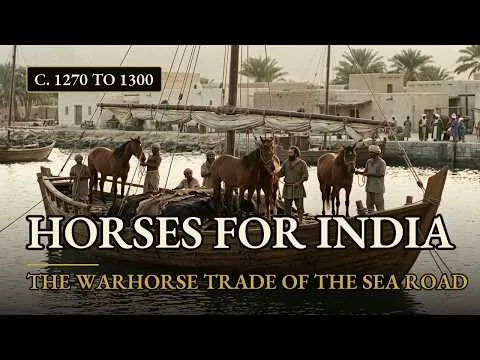
Picture a horse on a quay somewhere on the Persian Gulf around 1290, fed and groomed for sale. Soon it will be standing on a pile of hides in an open ship bound for southern India, and nobody expects it back. This week’s film follows that cargo. Here is a short guide to what the sources say, and where they go quiet.
Two witnesses, both imperfect
Nearly everything we know comes from two men. Marco Polo passed along the southeast coast of India on his way home from China in the early 1290s and wrote about the kingdom that Muslim writers called Maabar, ruled by the Pandya family. Wassaf, a Persian historian and tax official from Shiraz who worked under the Mongol Ilkhans, wrote about the same coast in the early 1300s.
Neither is an ideal witness. Wassaf is usually said never to have set foot in India, and he had once served the merchant prince of Kish, the man who ran the horse shipments, so some of his figures came from the sellers. Polo blends what he saw with what traders told him. The film names the speaker each time, and I’ve tried to do the same here.
Why Maabar kept buying
Polo was dazzled by Maabar. He calls it the finest province anywhere and says five brothers ruled it as kings. Wassaf calls it the key to India and says the riches of the Gulf islands came in good part from its trade.
What it lacked, both men say, was horses. Polo claims none were bred there, that one king wanted more than two thousand a year and that each of his brothers wanted as many. Then comes his grim arithmetic: by year’s end, fewer than a hundred would still be alive. Wassaf agrees that fresh horses had to be bought every year.
Why did they die? Polo blames the keepers. He says nobody there knew how to look after a horse, and there were no farriers, the craftsmen who shoe horses and care for their hooves. He goes further and accuses the dealers of keeping farriers away on purpose, since healthy herds would mean fewer sales. As far as we could find, that charge is Polo’s alone, though a modern study drawing on Persian sources says the dealers also shipped horses unshod.
Both writers found the feeding strange. Polo describes horses given boiled rice, boiled meat and other cooked food. Wassaf lists roasted barley, grain mixed with butter and boiled cow’s milk, then forty days tied in a stable to fatten, then hard riding with no training. Polo adds that even fine mares and stallions bred there produced crooked, feeble foals. Henry Yule, his great Victorian editor, thought that went too far.
From Kish to Kayal
Polo names five ports that sold the horses: Kish, Hormuz, Dhofar, Soer (which Yule reads as Sohar in Oman) and Aden, and elsewhere he adds Qalhat at the mouth of the Gulf. Polo puts a single Persian horse at about two hundred livres of Tours. Yule set that beside an ordinance of Philip III of France capping a riding horse at sixty livres, so Polo’s price was more than three times the cap, though the finest French horses could cost more.
The ships were the sewn boats of the Gulf, stitched with coconut-husk twine, with one mast and no deck. Polo says the cargo was covered with hides and the horses stood on top. No source we found describes life on board, how many horses a ship held, how they were watered or how many died at sea. Polo says only that many such ships were lost in storms. The survivors landed at Cail, probably Kayal, a busy port of Maabar where, he says, every ship from Hormuz, Kish and Aden called.
Wassaf gives the business side. Each year Jamal al-Din Ibrahim al-Tibi, who held Kish under the Ilkhans, was to deliver fourteen hundred horses at a long-fixed price of 220 dinars of red gold each, plus whatever more he could gather from Bahrain to Qalhat. Who bore the cost when a horse died on the way is disputed: the translation the film follows says the royal treasury, while an older reading says the contractor. Yule squared Wassaf’s price with Polo’s five hundred saggi by suggesting a red-gold dinar was worth about two ordinary ones. At the Indian end, a member of the same Tibi family, Taqi al-Din, served the Pandya king as minister.
What the horses became
Wassaf says the Pandya house split in 1310, when the lawful son killed the old king and was soon driven out by his half-brother. Modern accounts tell that succession differently, so treat it as Wassaf’s version. An army from Delhi under Malik Kafur then marched into Maabar and went home in 1311, and Amir Khusrau counts five thousand Arab and Syrian horses among the spoils.
The numbers are tempting to add up: fourteen hundred from Kish, two thousand for one king, ten thousand a year from all the ports in an earlier reign. But they come from different decades and different witnesses, so they cannot be read as accounts. Whether that horse on the quay lived to see a second year, no one wrote down.
Watch the film to follow the route, then use the sources below to test any of it.
Sources
- Marco Polo, ed. Yule and Cordier, vol. 1 (Persian horses taken to Kish and Hormuz; 200 livres of Tours; the sewn ships with horses on the hides; Yule’s note on Philip III’s price cap)
- Marco Polo, ed. Yule and Cordier, vol. 2 (Maabar and its five kings; 500 saggi of gold; the farriers and the cooked feed; Cail, Aden, Tana and Qalhat; Yule’s notes on the red-gold dinar and the Tibi family)
- Elliot and Dowson, The History of India as Told by Its Own Historians, vol. 3: Wassaf (the Kish contract of 1,400 horses at 220 dinars; the diet and the forty days; Abu Bakr’s 10,000 horses; Taqi al-Din; the Pandya succession of 1310) and Amir Khusrau (the plunder of 1311)
- Ali Bahrani Pour, “The Trade in Horses between Khorasan and India in the 13th–17th Centuries,” The Silk Road 11 (2013) (horses shipped unshod; the overland road to Delhi; Arabians for spices)
- Wikipedia, “Wassaf” (historian and tax official of Fars under the Ilkhans)
- Wikipedia, “Maravarman Kulasekara Pandyan I” (Wassaf’s reliability; a different modern account of the succession)
- Wikipedia, “Abu Bakr ibn Sa’d” (ruler of Fars, 1226 to 1260)
- Encyclopaedia Iranica, “India xiii. Indo-Iranian commercial relations” (Persian horses sent to India by land and sea)
- Elizabeth Lambourn, The Medieval Globe 2.1 (2015), abstract (the thirteenth-century sea trade in horses to the southern courts)
- Henry Yule, Cathay and the Way Thither, vol. 1, p. 494 (the older reading that put the loss of dead horses on the contractor)
- Thomas Wright, History of Domestic Manners, as cited by Yule (Philip III’s ordinance on horse prices)
- Joinville, as cited by Yule (a pair of fine horses worth 500 livres by 1309)
- Chamberlain’s 1874 report on stud matters in India, as cited in Yule and Cordier’s notes
This letter was drafted with AI assistance from the film’s researched script and its source notes. The sources are listed above; corrections are welcome and noted on the page. Send a correction